I guess this question applies to all Japanese aircraft carrying subs.
How much aviation fuel and how much ammunition did these subs carry for their planes? In other words, three planes were carried, but how many refuel and re-arm sorties could these subs support?
Also, did the Japanese intend to use the planes for scouting and reconnaissance?
As for ammunition, the Combined Fleet website listed the I-400 class of sub as carrying four aerial torpedoes, three 800kg bombs, and twelve 250kg bombs. No mention of aviation fuel storage.
Except for the I-400 (Type STo class), none of the Japanese aircraft-carrying submarines were designed to carry aircraft munitions (besides the 7.7-mm belts for rear-mounted machine guns on the aircraft). On several occasions, such as the I-25's attack on Oregon, relatively small bombs were carried, but this was by no means standard practice.
I don't have exact figures for the Type STo, but I suspect there were provisions for fuel for several sorties. However, the M6A1 Seirans were considered expendable and were not necessarily supposed to be recovered by the submarine, so the full fuel load may not have been carried or even built into the submarine as completed. As evidenced by the I-25's patrol off Australia and New Zealand, the Type B submarines had enough fuel for at least five flights.
Except for the Type STo class, the primary mission of Japanese submarine-launched aircraft was reconnaissance. Any sort of offensive armament was really an afterthought and the aircraft-carrying submarines were built expressly to be fleet scouts. The Wanatabe E9W1 could not carry bombs, and the Yokosuka E14Y1 was modified around 1943 to carry two 66-lb bombs. Fujita's E14Y1 carried two 148-lb bombs, although the aircraft could not land with any stores under its wings.
Jacob
Under Construction:
1/350 Typhoon
1/350 Skate
1/350 USS Nautilus
1/350 Tang
1/350 November
1/350 Hotel II
1/350 Alfa
1/350 George Washington
1/72 Type VIIC
This is a long read, but well worth the time. It details how Japan's submarine force was dismantled, studied, and for the most part, scrapped or scuttled. After the war, Japan's first submarine was a Gato-class boat, which served until they could build their own.
The (3) enormous Sentaka boats were of particular interest to the Soviet Union, which entered the war late against Japan, expecting to be given access to Japan's submarine technology. The US was fully aware of the possibilities these submarines offered and despite Russia's repeated protests, refused them access, towing them to Pearl for study and eventual scuttling. The information from these studies combined with captured German V-1 cruise missiles, (renamed, "Loons") was used to demonstrate surfaced missile launches for the Navy a short time later. The Regulus program followed, but the Polaris system made them obsolete.
Interesting article, although I wish it had more citations. By the way, Sentaka (High Speed Submarine) refers to the I-201 class, whereas Sentoku (Special Submairne) refers to the I-400 class.
Jacob
Under Construction:
1/350 Typhoon
1/350 Skate
1/350 USS Nautilus
1/350 Tang
1/350 November
1/350 Hotel II
1/350 Alfa
1/350 George Washington
1/72 Type VIIC
Interesting article on the Japanese submarine classes. Thanks CC for posting the link!
The large I-400 series are always a subject of interest. I have several books on the Japanese submarine force. Carpenter and Polmar�s �Submarines of the Imperial Japanese Navy�, Boyd & Yoshida�s � The Japanese Submarine Force and World War II�, � Imperial Japanese Navy Submarines 1941-45� by Stille, �Sunk� by Hashimoto, and the submarine chapter in Stille�s �The Imperial Japanese Navy �. All good resources for the Japanese Submarine Force.
One interesting side note is that at the end of the war, Hiram Cassedy, former captain of Tigrone, was appointed captain of one of the I-400 subs to bring in back to Pearl Harbor. Despite strict orders against taking souvenirs, Cassedy handed out several swords found on board. Admiral Halsey was so incensed, he ordered Cassedy relieved of command. Thus, Cassedy was the only US submarine commander relieved for cause of command of a Japanese submarine.
I agree. Interesting article. Thanks for posting. To add to Tom's list, there is a chapter in Paul Schratz's book Submarine Commander where he talks about bringing one of the Sentakas to Pearl. I think he was given command of it for the transit. He also talks some about readying and bringing all the captured boats back. I think he talked a little about the Sentokus. I'd give more detail, but my copy is literally down on my submarine right now so I can't double check.
I pulled out my copy of Schratz�s book. He did briefly inspect the I-402, and found it in deplorable condition. It had rotted rice stored in the engine room that had been soaked by fuel oil, due to lack of gaskets in the engines. Rats were everywhere. The sub had only one crude head and no shower facilities. When cleaning out the I-400 in preparation for the trip to Pearl, the sailors removed 12 gunny sacs of rats from the sub.
Schratz was assigned as the captain of the Japanese I-203, one of the high speed Japanese designs, which he brought to Pearl Harbor. This was the Japanese equivalent of the German Type XXI submarine. He describes it as having an underwater speed of 19 kts., and 4,192 automobile size batteries. On the plus side, it has a German Balkon sonar, an early type of curved array with multiple transducers, and a very good German made radio. On the minus side, it had poor HOR type diesels and terrible radar. He says that some of the original parts, spare parts, and blueprints were missing.
The big I-400 boats made a separate crossing to Pearl a few weeks earlier than the high speed I-200 series submarines. All were tested and then sunk, mainly to keep them out of the hands of Russia.
The examination of the I-400 and I-14 are in report S-01-7.
Jacob
Under Construction:
1/350 Typhoon
1/350 Skate
1/350 USS Nautilus
1/350 Tang
1/350 November
1/350 Hotel II
1/350 Alfa
1/350 George Washington
1/72 Type VIIC
I know this question was asked on page one, but did not see any answer. What would be the dive plane position when launching aircraft? I know during "regular" surface cruising they were retracted. Not sure if they'd be out for a crash dive and/or additional stability while launching aircraft. I suppose closing up the hanger would take more time than rigging out the dive planes, so I suppose they'd still be closed unless they conferred anything for stability while launching.
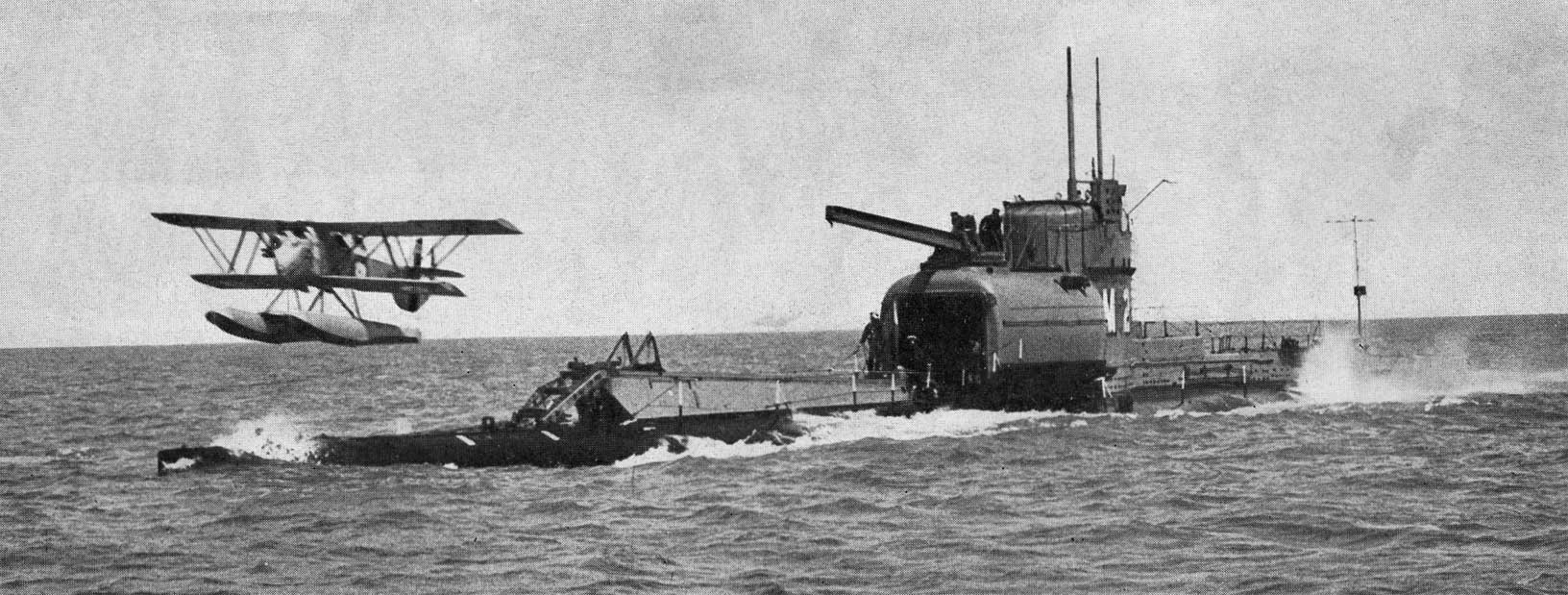
I wasn't aware of the British tests with aircraft carrying subs, so just quickly glancing assumed this was the I-400. Now after repeating this search, I see that it's not and I am back to sharing your thoughts the dive planes were too high to add value when surfaced. And my understanding of a "crash dive" is that it was more dependent on ballast tanks than the planes.
ESzczesniak wrote:I know this question was asked on page one, but did not see any answer. What would be the dive plane position when launching aircraft? I know during "regular" surface cruising they were retracted. Not sure if they'd be out for a crash dive and/or additional stability while launching aircraft. I suppose closing up the hanger would take more time than rigging out the dive planes, so I suppose they'd still be closed unless they conferred anything for stability while launching.
Bow planes would be hard pressed to provide stability to a surfaced submarine unless they were gyro controlled. Manual actuation or hydraulic actuation under manual control can never react well enough to sub motion to provide much stability.
In any case to provide stability they would need to be a significant distance underwater when the sub is surfaced and trimmed for aircraft operation.
Assessing the impact of new area rug under modeling table.