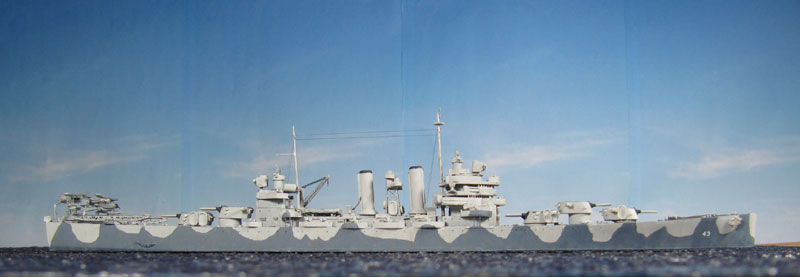
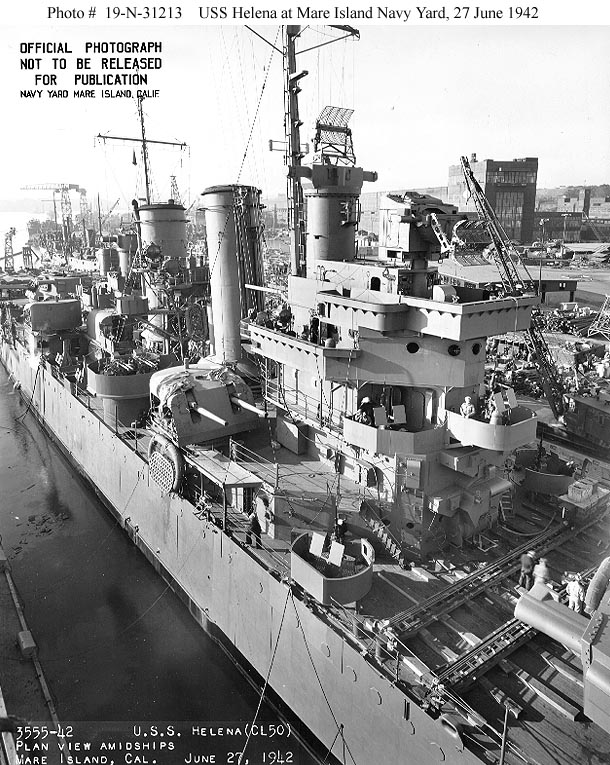
Yes two quad 40-mm mounts could fit in that location.
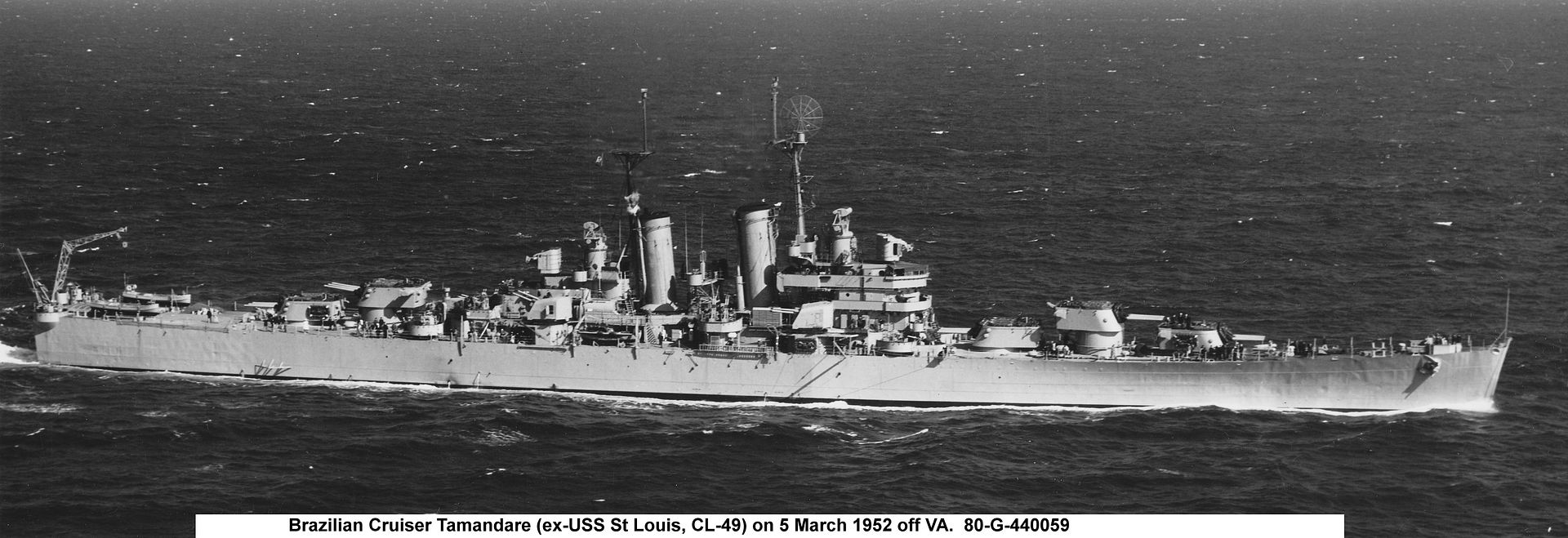
This image is of USS ST LOUIS after being transferred to Brazil, but you can clearly see her end of WWII configuration included two quad 40-mm mounts in that location.
Moderators: MartinJQuinn, Timmy C, Gernot, Olaf Held, Dan K, HMAS, ModelMonkey
Hey David - yes, those guns are visible in the July 1942 Mare Island photos of CL-50 after refit. They're hard to make out, but please see below:DavidP wrote:Ian, are you certain there was 2 quad 40mm aa guns sitting side by side at that location forward of the #4 6" gun turret as awfully tight space there for those 2 mounts?
Hey Rick - my drawing depicts HELENA (CL-50) in July 1943 and not ST LOUIS. I have done another version of ST LOUIS in 1944 with dazzle camouflage, but have not yet updated it with a plan view. Eventually I would like to draw ST LOUIS in the 5 July 1943 configuration.Rick E Davis wrote:Ian,
I'm pretty sure that wasn't the configuration for USS ST LOUIS in July 1943. More like July 1944 (when she was painted in dazzle) with additional changes like searchlight tower removed.
Phil, as always really appreciate your detailed reply and the advice you give on NARA trips and best practice for researching microfilm, etc. I am located in the Denver area so a trip to NARA is out of the question at this time (and anyway we have our first baby on the way in April...)DrPR wrote:Ian,
I suspect the prop positions in your drawing are for the early Brooklyns, and St. Louis and Helena had them a bit farther aft - but that is a poorly educated guess!
You could just order the microfilm on DVD from the National Archives and save the cost of a trip (depending upon where you live). I am in Oregon so a trip is just not practical. It was cheaper for me to order all of the Cleveland class microfilms.
Unfortunately, I suspect there will not be a single index reel for the Brooklyn/St. Louis class. The USS Cleveland CL-55 microfilm has an index at the beginning of each reel listing only the blueprints on that reel, so I had to order all 19 reels. Most were door and furniture lists, lists of label plates over doors, wiring, plumbing and ventilation diagrams, etc. of no use for modelling. However, by the time of the modified Cleveland in the early 1940s each collection had a separate index reel that listed all blueprints on all physical reels. This was very useful for determining if a desired blueprint was actually in the collection. Many of the Cleveland blueprints were lost and are not in the microfilm collection.
****
The drawings are in the same order on the microfilm as the Ship Material Group Codes (attached). If you know the number of reels in the drawing collection (the Archivists can tell you that) you can guess which reel might contain a drawing you need. However some material groups are larger than others, and some may fall across multiple reels.
Fortunately, information about the position of the propellers will likely be on reel 1 in the S1 Design of vessel and S7 Docking (drydock) sections. S1-3 has general plans (but not necessarily accurate) and S5 Molds has hull line plans. Section S11 Hull structural and S12 hull fittings will contain the actual construction blueprints showing individual hull plates, etc. All of these sections should be on reel 1. But if there is a separate index reel (the Archivists can tell you this) the plans will start on reel 2.
S43 Shafting and bearings (S43-2 Bearings) has drawings of the propeller shaft struts and S44 Propellers has the prop drawings. In the Cleveland plans the prop struts were on reel 2 and the propellers on reel 10 along with some shaft details and fairings.
****
A word of caution: There are reels and there are reels! For some reason the entire collection of drawings for a ship is called a "reel." So the Cleveland drawings are microfilm Reel # 5537. But in this collection there are 19 physical reels of microfilm containing 4630 individual blueprints. But each individual blueprint may have been photographed in as many as six overlapping "frames" or photographs.
I got all of my copies on actual microfilm (before the Archives started offering scanned images on DVDs). I do not know how they organize the images or frames on the DVDs. Each physical reel may be scanned to a separate DVD, or multiple physical reels may be placed on one DVD. You need to ask an Archivist about this.
Hope this helps.
Phil
 What I get for going online after midnight.


Not if you understand how she was built.... The Roma was built in typical standard shipbuilding style, a keel which forms the backbone and frames which form the hull shape.... The USS Savannah was built to an entirely different style, her keel was only the bottom of a longitudinal framing system which formed a box beam for the length of the hull...... Much much lighter and just as strong if not stronger that a keel laid ship....Fliger747 wrote: Amazing that the Savanna survived a hit that destroyed Roma. Apparently a lot of the force of the explosion was vented outboard via a relatively light structure.
Hey I'm always cracking the whip can while cruiserin around for pumpkin pie..... (especially around virginny)Rick E Davis wrote:... OR TWO pumpkin pies. And don't forget the Whip Cream.
From Cruisers to Researching at NARA to Pumpkin Pie ... ?

Learn something new everyday, I thought the Fritz X was one of those glide bombs they were using during the period, but it was actually a radio controlled AP bomb..... Thank you for that pointer.....Fliger747 wrote:The damage report drawings supplied by RED seem to indicate a warhead explosion around the third deck, not below the ship. It is possible, but HEAT warheads tend to not be effective against ships because of the distance between decks and bulkheads which disperse the "jet". For instance when used against tanks, the effects might be bad for the occupants, but if nothing was ignited a weld over of the hole and a general "cleaning" of the interior and the tank might be back in service. Advancing across Normandy a great number of M4's were returned to service.
In the case of Roma the containment of the explosion and subsequent sympathetic magazine ignition by the strong armor box magnified it's effect, much in the manner of HMS Hood. If I take some of my smokeless powder and pour it out on the patio and touch it off, it burns with some enthusiasm, but does not explode. Confine it and it makes the satisfying boom that propels the shell out of the barrel.
The info I can find indicates an armor piercing bomb with a heavy case. HMS Uganda (Escort carrier) did have the bomb pass completely through the ship with the explosion occurring underneath the ship.
Still a surprising event in the "less is more" vein.
About two thirds of the way through the naval battles around Guadalcanal, the Japanese naval forces in the area came up with a nickname for the Brooklyn class cruisers... "Machine Gun Cruisers" is what they disgustingly referred to them as in reference to their ability to throw shells very quickly..... (an improved ap shell design as well, introduced in 1940, capable of penetrating the same amount of armor as a standard 8" 55 ap shell)Fliger747 wrote:Those 15 gun light Cruisers were amazing by the sheer volume of fire they could maintain!