Page 6 of 6
Re: Pomeranian Rahschlup 1846 � 1/160 scale � Baltic trader
Posted: Thu Jul 30, 2026 3:55 am
by wefalck
I have been against using polystyrene on model due to its inherent lack of long-term stability - plasticisers tend to diffuse out making the material brittle, but for miniature models it does have many advantages. I know, some of the 'classical' miniaturists would throw up their arms in horror ...
Acrylic glass (Plexiglas) on the other hand has been demonstrated to be long-term stable over many decades and is easy to work with, of one observes certain rules, such as not too high tool-speeds and moderate feed-rates to allow the working heat to dissipate - it has a rather low thermal conductivity.
Last night, I set up the dividing attachement on the milling machine, but still need to do some drawing and produce a working drawing with measures pencilled in. The plan is to have a go at it over the coming weekend - it seems that outside temperatures and thus workshop temperatures will stay in a bearable range.
Re: Pomeranian Rahschlup 1846 � 1/160 scale � Baltic trader
Posted: Sat Aug 01, 2026 3:34 am
by marijn van gils
I'm looking forward to that!

I'm using a simple fan in the workshop when temperatures rise, pointed at me. Helps me a lot to stay modelling in the summertime!
I understand that plexi is more stable than styrene, but for this model that shouldn't be an argument. There is already plenty of styrene on it!

Luckily, the stability of sterene is not to bad, at least when painted an kept out of direct sunlight. A friend of mine who has restored a number of models and box dioramas by Sheperd Paine from the 70ies and 80ies, noticed how lead items have correded away from under the paint, how natural materials (like tree roots to make miniature branches and trees) have become very brittle and crumble, and how the electronics fail, but the styrene and epoxy putty items don't seem to have deteriorated at all after 40 - 50 years. That doesn't mean it will hold up as long as plexi of course, but it's not too bad compared to the longevity of our own bodies

But to be clear, I'm not trying to convince you here (just some fun discussion)! I understand you feel very comfortable with working plexi as a material, which is maybe the best reason for using it.
Re: Pomeranian Rahschlup 1846 � 1/160 scale � Baltic trader
Posted: Sat Aug 01, 2026 3:49 am
by wefalck
There is a difference between polystyrene-sheets or -profiles and the stuff used in injection moulding. The latter seems to contain less plasticisers. I haven't looked into the boxed kit-models that I built in the late 1960s and early 1970s, but when I last looked, they seem to have been holding up quite well. But then they have been in their box since the mid-1980s at least. The same seems to apply to my treasured boyhood collection of WIKING-car models that dates back as far as the late 1950s.
Re: Pomeranian Rahschlup 1846 � 1/160 scale � Baltic trader
Posted: Sun Aug 02, 2026 7:28 am
by wefalck
Machining the mast – first attempt
OK, turning the mast from 3 mm acrylic rod didn't work. First tried the larger watchmaker's lathe, but couldn't bring the fixed steady close enough to the point of work. Switched to the smaller lathe, which has a steady specially for thin material, but the rod still flexed and jumped over the cutting bit. Brass is siffer, but still not stiff enough I think. Have to go back reoentantly to steel - this will now call for some serious soldering and micro-metal work, not just cementing plastics.
Simply tapering the rod with wet-and-dry paper could perhaps have worked, but I like to turn-on the iron bands - looks much crisper than adding them later.
It's becoming to warm now in the workshop - another oncoming heatwave plus the internal heat from frustration. Have to give it a go at another day.
In between, I also drew the cargo winch, based on a drawing from the Danish archives for a little topsail schooner of 1852 (G-5204-17,
https://arkivalieronline.rigsarkivet.dk/)
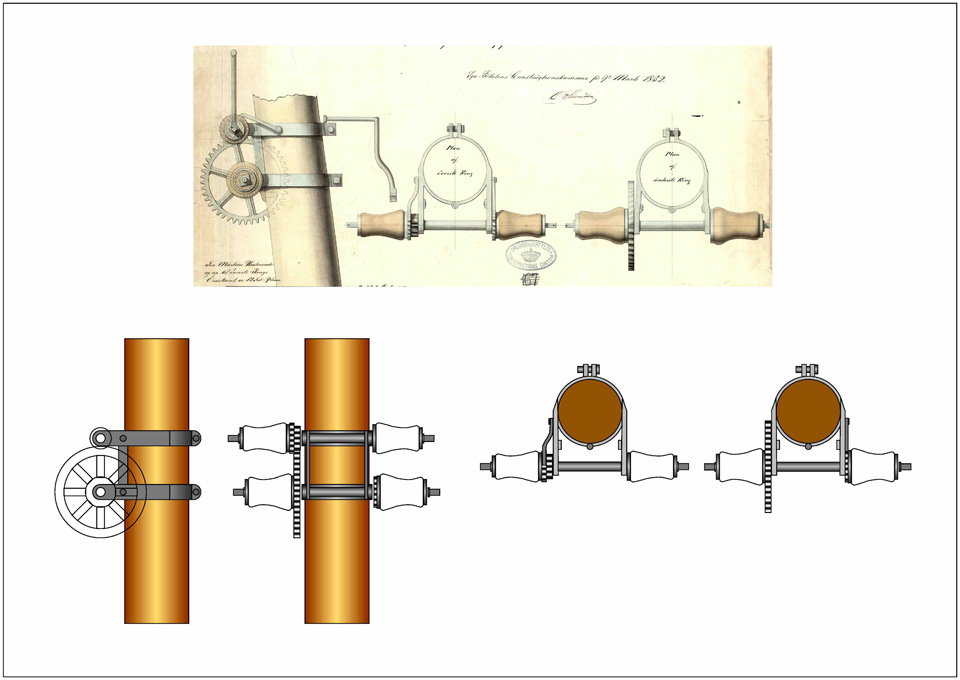 Working drawing for the cargo-winch attached to the mast
To be continued …
Working drawing for the cargo-winch attached to the mast
To be continued …