Page 2 of 11
Posted: Mon Oct 23, 2006 11:54 am
by Steve Sobieralski
Continuing with work on the superstructure subassemblies:
The after control station sits atop the forward end of the aft superstructure, immediately behind the aircraft catapult. I have not been able to find much specific information regarding this structure, but I assume that it contained an emergency conning station and what appears to be windowed galleries along the sides probably had some sort of observation or spotting function.
It was raised one level above the superstructure deck on a number of x-braced columns, which gives the structure a curiously ramshackle appearance similar to a beach house on stilts. This method of supporting the structure may have been a weight saving measure as these ships were built extremely close to the 10,000 ton displacement limit set forth in the Washington Naval Treaty. Access to the interior was presumably by ladder through a hatch in the floor of the structure.
The after director tower is also part of this structure and as originally built there was also a high angle range finder and director on the roof. During the 1937 refit h/a range finder was removed and two tubs for the eight-barrel pom-pom directors were placed there.
Posted: Sat Oct 28, 2006 10:31 pm
by ModelMonkey
Steve...

Posted: Sun Oct 29, 2006 4:02 am
by JIM BAUMANN
a County class- very pretty indeed!!
Looks like a great model in the making..
yet ANOTHER thread to be watching!!

Jim Baumann
Posted: Sun Oct 29, 2006 5:10 am
by Dave Wooley
Excellent work !
Dave Wooley
Posted: Mon Oct 30, 2006 4:17 pm
by Steve Sobieralski
More work on the superstructure.
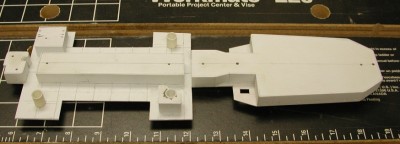
The main superstructure cabin boxes were constructed quite quickly. The floors of the boxes were cut per the plan (minus the thickness of the cabin sides) from sheet plastic and strips for the cabin sides were pre-cut to the proper dimension for height. They were then cut to length and portholes were drilled in them and backed with plastic strip. The sides were then glued to the cabin floors. The decks above overhang the cabin sides in some instances, particularly where the secondary armament and pom-poms are sited. These were cut per the plan and cemented to the sides. The photo below shows the forward superstructure from the bottom. The angled front end of the fore cabin is to the left. The long thin cabin in the center is mostly taken up with the funnel uptake and engine room air intake ducting while the small cabin at the rear is the blacksmith shop. Deck beams are being added to the underside of the deck and the tubes and small cabins at the sides under the deck extensions are the secondary gun foundations.
The following three photos show the superstructure temporarily installed on the hull. A copy of the deck plan has been cut to shape and placed on the hull to guide placement.
The small structure between the main superstructure blocks is the torpedo assembly shop where reloads were stored and the torpedoes maintained. Atop this structure was the catapult turntable. (The torpedo tubes shown on the deck were provided in the original semi-kit and will not be used.)
CPVC water pipe, which is conveniently the proper diameter, is utilized for the funnels. The fore and aft funnels are circular in plan and just had to be cut to the appropriate length and angle. The center funnel is longer than the other two and was made by splitting some of the pipe in half and joining the two sections with plastic strips, then cutting it too the same length and angle as the other two.
This photo shows all the components so far constructed assembled on the hull. I like to put everything together periodically as it allows me to visualize the completed model and helps maintain my enthusiasm.
Finally a shot of the foredeck showing the initial steps in laying the wood deck.
Posted: Mon Oct 30, 2006 5:13 pm
by Filipe Ramires
Awesome job, Steve. You work really fast I can see.
Posted: Mon Oct 30, 2006 6:17 pm
by JIM BAUMANN
Magnificent looking progress!
the shot of her on the shelf... It looks just so... well ... County class!!
Excellent looking progress-look forward to seeing more!
Jim B
Posted: Mon Oct 30, 2006 6:29 pm
by ARH
Hi Steve, your making a grand job of the build, I like the part where you say you have reduced the size to allow for the thickness of the plastic, I thought it was only me that did things like that.

Posted: Mon Oct 30, 2006 7:24 pm
by Laurence Batchelor
Ahhh County class, County class..... harking back to Edwardian warship architecture in the 20th century, so tasteful those types at Bath and alike designing these beautiful ships.
I'm watching this thread with great interest and it seems your building her so fast Steve
Posted: Tue Oct 31, 2006 3:45 am
by Ludwig
won-der-full work Steve ,
I am speechless.
regards,
Ludwig
Posted: Tue Oct 31, 2006 4:04 am
by Neptune
Hi Steve, great build and an extremely fast one!
One big question though. How do you cut that styrene so straight? I'm working on my own styrene build (in Picture post forum as I don't think she fits here) and I'm having plenty of problems in cutting the styrene parts straight... It's very slippery when you want to cut it with a stanley knife, I guess you use something different?
I am happy to see that when you build a locker, you also have problems with fitting the roof in a 100% correct way. At least I'm not the only one having part of the roof popping out on one side and being below the edge of the walls on the opposite side.
This ship is starting to look pretty cool! The wooden deck will be awesome!
Regards
Roel
Posted: Tue Oct 31, 2006 8:16 am
by Steve Sobieralski
Thanks to all for the comments and encouragement so far. The build is proceeding rapidly for a few reasons:
1. When I remarried about four years ago I (gladly) gave up my model work room to be my new stepson's bedroom. I've just recently been able to get a new shop up and running, so after about a five year hiatus I'm ready to build something. Building Dorsetshire is also great inspiration in itself as it is something I've wanted to do for a long time.
2. Obviously, when you start with a ready-made hull you start out way ahead of those that choose to build their own.
3. What I've been doing so far has been the easy part. I trained as an architect and spent many hours at school making mass models from thin cardboard. Ship superstructures are basically buildings sitting on decks, so this goes quite quickly for me. Once the detailing starts things will slow down.
4. Things have already slowed down now that I have started the deck planking. I'm doing it plank by plank and it is enjoyable, but slow work. I'll post some progress photos in a day or two.
Roel: I don't really have any special technique for cutting plastic. I mostly use a #11 xacto knife and a cork-backed metal straight edge. I usually make the first pass with the knife very lightly to establish a groove for following cuts if required. You don't need to cut the plastic all the way through, just scribe and break it and clean up the edge with a light sanding. I looked at your build and it looks like you're doing just fine to me!
Posted: Tue Oct 31, 2006 8:32 am
by Foeth
I switched from X-acto to ordinairy Stanley knifes. They last longer. Incidentally, nice progress shots!
Posted: Tue Oct 31, 2006 9:35 am
by Steve Sobieralski
I'm afraid I don't know what a "Stanley Knife" is. Could somene enlighten me?
Posted: Tue Oct 31, 2006 9:37 am
by Foeth
One of those:

Posted: Tue Oct 31, 2006 10:37 am
by Steve Sobieralski
Ah, I've got one in my drawer at work actually. Never considered using it for modeling. I'll have to give it a try.
Thanks.
Posted: Tue Oct 31, 2006 11:12 am
by klein loewietje
I concur with Foeth, I use a Stanley as well for the 'heavier' work, and a N�11 for the finer stuff.
Your Dorsetshire is coming along nicely, I'm following this with great interest!
Greetz, Johan
Posted: Fri Nov 03, 2006 11:38 am
by Steve Sobieralski
Well, as I expected, progress on the deck planking has been somewhat slower.
I am planking the deck using individual bass wood strips obtained from Kappler Mill & Lumber Co. Prior to commencing the build I ordered 500 24� long HO scale 2x2s, which should be enough to plank this model and leave some for the next. At 1/192 the HO 2x2s scale out to about six inches wide, close to what the prototype planks appear to be from photos.
After the deck is completely laid it will be sanded down for a uniform surface and will end up closer to the correct scale thickness of about two inches. I don�t know how long the planks were in reality, but I am assuming 16 feet, which makes them a convenient one inch long in scale. Every fourth plank aligns so the overlaps are four feet or � inch in scale. I use a very simple jig to cut the strips to length with a scalpel blade.
I started at the bow. Unfortunately, Dorsetshire is one of those ships that had planking virtually all the way to the tip of the bow, instead of a painted steel forecastle which would have been much easier. This means that the planking has to be fitted around all of the anchor gear and makes progress in this area even slower.
The first step is to put down a border strip at the edge of the deck and around all major fittings such as cabins, hatches, bollards, etc.(This was shown in the last photo of my previous post). I believe these were called "cutting planks" in actual practice. The cutting plank at the deck perimeter is inset from the edge of the hull as a waterway and is where the railings will eventually be placed.
The strip around the barbette was easily formed by wetting the wood, bending it around the barbette and then leaving it secured there overnight. To glue the wood to the plastic sub-deck I use Faller "Expert" plastic cement, a German product that I obtain from Walthers, a model railroad mail-order house.
Some of the fittings such as the hawse pipe lips and bollards are shown temporarily in place. For the chaffing plates under the anchor chains I am using Gold Medal Models photoetched brass treadplate.
The above photo shows the decking completed to the breakwater and progressing aft around A barbette.
Posted: Sat Nov 04, 2006 9:39 am
by bwross11
Steve your desk looks amazing! I've tried laying a deck in this manner and really appreciate the job that you've done. Keep up the good work.
Best,
Bruce
Posted: Sun Nov 05, 2006 5:08 am
by Ludwig
hallo Steve,
She is coming along nicely. Very impressive build , lots of work is going into planking , but the end result will be great. Look forward to the next up-date.
regards,
Ludwig