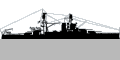
Vladi,
This film from April 1, 1941 has camera crews on two ships. One is USS Arizona and the other is USS Louisville. There are a couple of scenes showing Louisville hanger doors. https://www.youtube.com/watch?v=EMlSGtAFi-E&t=373s
Thanks, Jeff, that is an excellent find. So Louisville had hangar door variant "B" at that time and she still had it on 11 November 1942 as seen at NH 94429.
Hi folks, anybody has an idea how the non-skid stripes shown below looked like? I presume these were smaller rectangular sheets (rubber?) attached (glued?) side by side to the deck with their longer side perpendicular to the lenght of the ship. Is that right?
These were a thin piece that was applied to the deck that had a rough texture, similar to items sold here in the US for boating and RV�s for the same purpose. The Northampton shows these off well.
Close up of the ones on the upper level of the forward superstructure
0C7CC824-5825-40A9-A1D0-7FF328A914CE.jpeg (47.47 KiB) Viewed 6098 times
Note the wheels for the Aircraft Crane tucked behind splinter shield both Port and Starboard
8A50DDD3-C144-4EE7-836F-32E0266A6A0B.jpeg (49.41 KiB) Viewed 6098 times
When I was in the Navy (early 1970s) the non-skid strips were about 18" long (45.7 cm) by 6" wide 15.2 cm), with rounded corners, and adhesive backed - that is just an approximate size. They were flexible and had a sand coated surface. I think they came in rolls, attached to waxed paper strips to make it easy to get them off the paper. I don't know if they were produced this way during WWII, but they appear to have been the same size. Once something gets a Federal Stock Number (FSN) it never really disappears from the supply system.
We stuck them anywhere we needed good traction on decks, inclined ladder steps and wherever there was wear on the paint. For example, they might be placed on bulkheads where ladder rungs were positioned so the toes of our shoes wouldn't scuff the paint. That way we didn't have to repaint as often.
I don't know if there was any "correct" way to orient them. Most likely it was at the whim of the Division Chief Petty Officer. I have seen them arranged in concentric circles around 20mm and 40 mm gun mounts.
Another way to get a non-slip surface was to coat the deck with a mixture of sand and paint. The adhesive patches were simpler and faster with no clean up afterward.
Phil
A collision at sea will ruin your entire day. Aristotle
Yes, it�s quite common in these photos. Good that we know where the 5in fuse-setters should be Also aircraft markings are helpful on some of the other photos.
That is the spotting glass (telescope) for Secondary Conn & Aft Spotting Station, below the Sky Aft position. It was badly sited and not v. useful, and did not require much personnel to man.
A LT(jg) or ENS might have command of that position.
Friedman's "Naval Firepower" describes the main battery directors for the NORTHAMPTON class in some detail. Mark 24 Mod.0 was the shielded director atop the foremast ("incorporating a Mk VII spotting glass"). The Mark 24 Mod.1 director was the unshielded director located in the protected position aft of the funnel. Later on the aft director was relocated to the mainmast (below the Director Mount Mark 1 - the enclosed Mark 19 director system for 5" guns).
Here is a picture of the director from the same book (interestingly, the caption notes "Mk 24 Mod 3", so good chance this is a later model/wartime version)...
Last edited by Ian Roberts on Mon Dec 16, 2019 4:54 pm, edited 1 time in total.
Thanks a lot! I�ll have to scratchbuild something along these lines so that the station is not completely empty. There won�t be much of it visible in 1/700, and I can even put a canvas cover over it
I assume you were asking if accommodation ladders were "stored" on deck when underway?
I can't speak for the Northampton, but is was common on other US cruisers to store the large parts in fixtures on the sides of the superstructure, hanging beneath overhead decks, on weather decks, or even placed along the edge of the main deck with the lifelines. The smaller parts such as stanchions, life rails, hand rails, chains, tackle and such were stowed in gear lockers.
The stowage arrangements changed from time to time with overhauls and perhaps at the whim of the ship's Captain or crew. You need to know the ship type, the period you are interested in and have photos of the particular ship to refer to.
Phil
A collision at sea will ruin your entire day. Aristotle
thanks for your feedback! Yes, that�s exactly what I�m looking for. As my focus is the Battle of Savo Island I am especially aiming at USS Chicago in August 1942, but there are not many good close-up photos of her in that period so any timeframe would help. Accommodation ladders were deployed from the well deck on the Northamptons so I�d expect them somewhere in that area. I cross-checked my photos of her class and I think I found one of the Northampton showing the ladder stowed under the back of the bridge behing the sweeping party here:
The situation on the Chicago was different because of her extended forecastle with flag facilities but I consider it likely accommodation ladders would be stowed in an analogical place on her shorter well deck, although I don�t have any direct evidence for that. I hope you�d agree.
BTW you mentioned hanging accommodation ladders on lifelines - that was clearly a common practice e.g. in RAN as seen on some photos and depicted on my build of HMAS Canberra.
Those Cruiser essay pictures are very nice. I had a few questions, sorry if they've been asked already.
Would the anti skid have been there during the end of 1941?
This destroyer that seems to be resupplying from Northampton, looks to be a Porter class, is that correct? (I think one of the photos is reversed? Or were they resupplying off both sides?)





 Also aircraft markings are helpful on some of the other photos.