ADavies wrote:Option one. A single white plus (+) sign applied to either side of the tail. This strikes me as the most likely.
Option two. A single white vertical stripe applied to either side of the tail, and a white stripe applied to the port wing. It is my understanding is that this was the marking adopted in 1945 and so is outside of the timeframe I�m hoping to represent.
Option three. A two digit number on the tail, underlined with a single horizontal white line. This is shown on the rear cover of the AOTS covering Intrepid. And is (unhelpfully) dated as 1944.
Does the Trumpeter 1/700 Franklin kit depict the ship in her 1944 or 1945 configuration? I recently read that the Franklin lost her hangar deck cat prior to her first deployment, but did not get a port flight deck catapult until her refit at the end of 1944.
Mikevpd wrote:Does the Trumpeter 1/700 Franklin kit depict the ship in her 1944 or 1945 configuration? I recently read that the Franklin lost her hangar deck cat prior to her first deployment, but did not get a port flight deck catapult until her refit at the end of 1944.
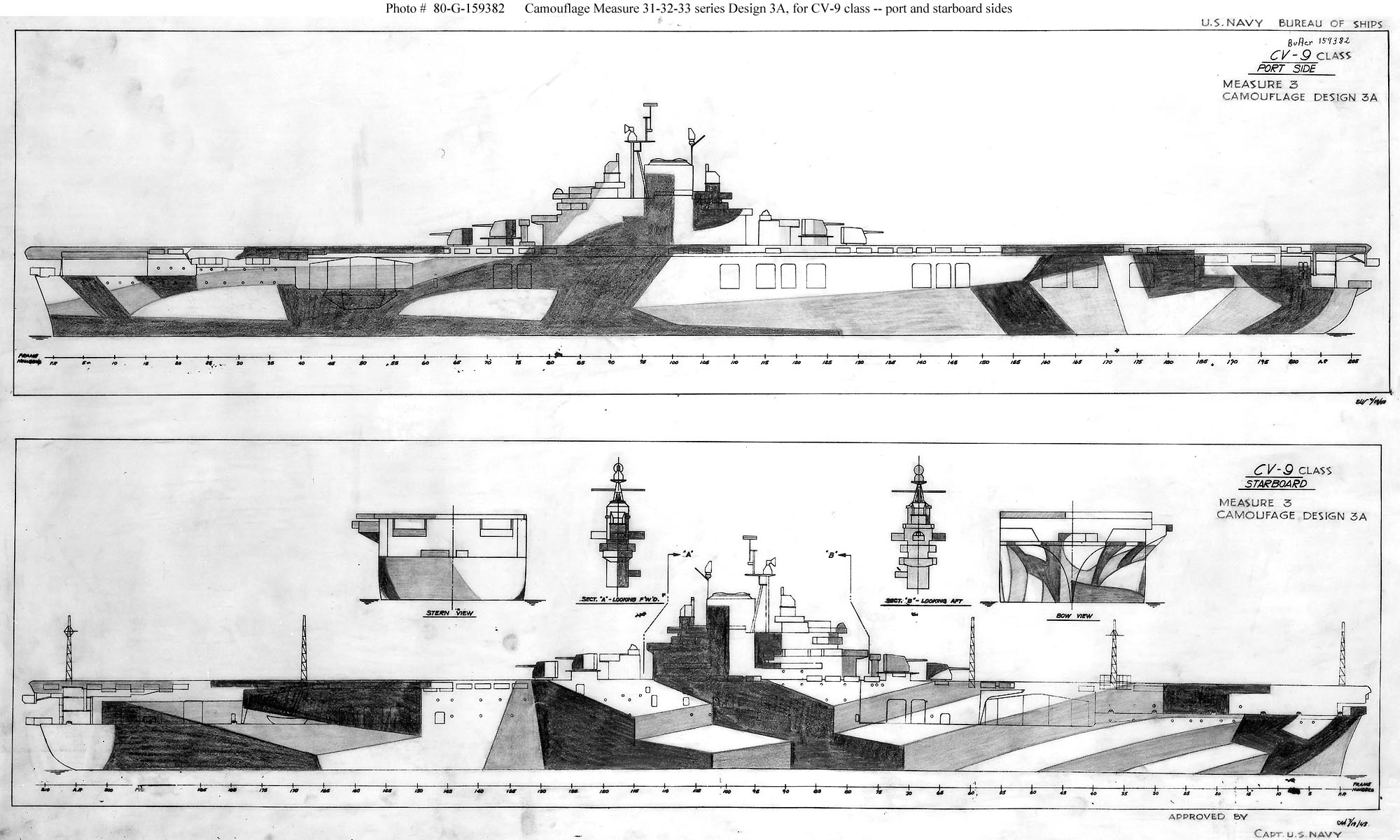
Trumpeter 1/700 Franklin kit (like 1/350 Trumpeter kit) represents 1945 configuration. Of course there are some mistakes. But color painting guide you will find inside the box shows the ship in dazzle paint scheme (MS 32/6a (Starboard)/MS 32/3a (Port)). So it is right only for configuration from the second half of 1944.
I have a technical question about my current WIP build of 1:350 Trumpeter USS Hancock. I've attached two photos of where I am at present with the hull, along with a photo of the ARTWOK wooden flight deck for forward section. My question has to do with the two steam catapult channels on either side of the forward elevator on flight deck. ARTWOK kits come with minimal instructions or hints, so I'd like to ask the Essex Class modelers in the group, how to deal with these catapults. It is apparent that the catapults could be cut out per the lines on the piece, but should they? Additionally ARTWOK provides a second set of outline cutouts that includes the two catapults. Should these be pasted on top of the ones included in the deck section, or should the ones in the deck section be cutout and left empty to give some 3-D depth down to plastic deck section? In all of the many Hancock photos available, I haven't located any which show closeup catapult detail. I also have not seen any indication that catapult parts are included . I have the ToM's Modelworks set for Essex carriers, which includes arresting cable tiedowns and crash barrier supports but nothing for catapults.Any suggestions will be gratefully accepted. Thanks.
When did she receive the two quad 40mm mounts on the port side aft of the deck edge elevator? Sources I have checked say either early 1944 or mid-1945.
Thanks in advance.
Last edited by Mikevpd on Sat Dec 01, 2018 9:45 pm, edited 1 time in total.
Mikevpd wrote:When did she receive the two quad 40mm mounts on the port side aft of the deck edge elevator? Sources I have checked say both early 1944 or mid-1945.
The two quad 40MM just below flightdeck level aft of the port side elevator were part of a "package deal" that was fitted to the Essex's. Those along with the three ouboard of and below the island on the starboard side were referred to as "outboard quad 40MM". The package generally included extending the two starboard, after hangar deck level mounts further outboard as well. (All of the outboards had to be removed to transit the Panama canal.) Lexington was the first of the class to receive the mod, and the only Essex to have the mod while retaining the quad on the face of the island. She was torpedoed in early Dec '43, and the outboards were installed during her repairs - completed by the end of Feb '44.
Not quite ready yet, but what color were the 20 mm & 40 mm armament painted? Were they painted to match the camaflouge color where they were mounted or were they painted a neutral gray color?
Stuch wrote:Were they painted to match the camaflouge color where they were mounted
They were painted to match the surrounding camouflage
Martin
"Tomorrow is the most important thing in life. Comes into us at midnight very clean. It's perfect when it arrives and it puts itself in our hands. It hopes we've learned something from yesterday." John Wayne
Was there an arrangement, set of standards or order by which the different types of aircraft were stored and maintained on the hangar deck on WWII era Essex class carriers?
Bullet175 wrote:Was there an arrangement, set of standards or order by which the different types of aircraft were stored and maintained on the hangar deck on WWII era Essex class carriers?
Spotting & spares has been something I've been trying to research at the archives the last couple of years with no success. A lot would have depended on year as things evolved over the war, and may have depended on the strikes and munitions used (heavier bombs would put some planes further aft in the deck strike for a longer take-off run until the use of the catapults became more wide spread). The engine and prop shops were at the aft end of the hangar bay, so heavier work around the powerplant probably took place there. A lot of times when there was a "dud" plane (either engine problem on take off or accident on landing) they would move it below as quickly as possible via the deck-edge elevator, so my guess is that there wasn't a lot parked here permanently during operations to leave room for these aircraft.
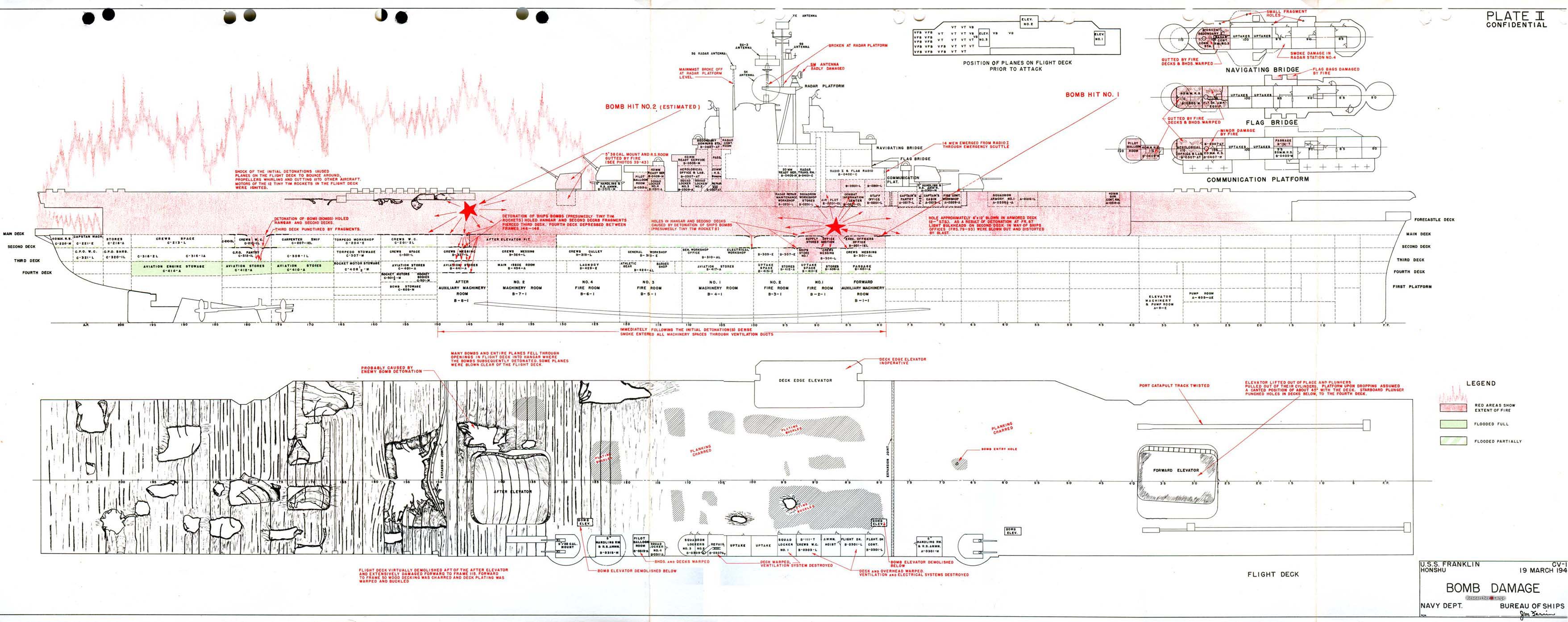
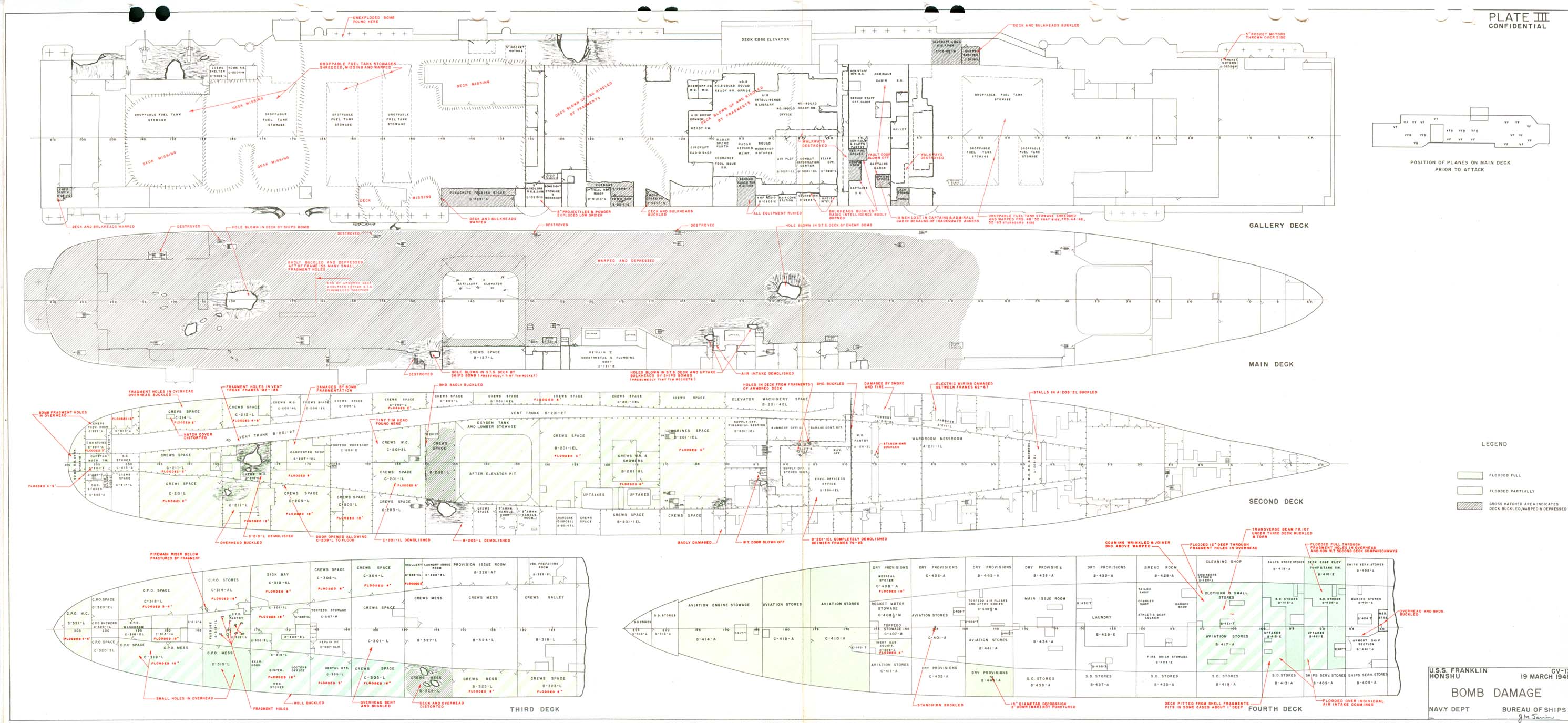
The closest thing I have to a parking plan is from CV-13 Franklin's 1945 damage report, where Plate 2 maps out the deck strike and Plate 3 maps the hangar deck spot at the time of her bombing. Paragraph 3-28 states that six aircraft in the hangar bay aft were defueled and not armed, indicating to me they weren't taking part in the strikes and were probably down for maintenance or spares.
I'm sure this has been addressed, but this thread is over a hundred pages long...
I want to make a 1/350 Intrepid.. I'm very amateur. I can make the kit, and paint it so it looks ok from 5 feet off. I am not talented enough to make custom parts and I normally discard any photoetech I don't consider really necessary. What kit is the best approximation of her in WW2? Essex, Yorktown? What easy modifications can be made to either kit to be more accurate? Honestly, given my skill level, it may be best to take whichever available model is closest and just slap an 11 on the deck with the appropriate paintjob.
For reasons beyond my control I have to live in NY for the better part of a year at least (which I know is amazing for so many, but it's outside my comfort zone, and it's keeping me from my family when I really think I need to be there for them- but I'll skip the long story) and I just want to make the best of it.. And for me, appreciating the Intrepid is the best I can do (She reminds me of home, where the Yorktown is spending her retirement and I'm a frequent visitor.)
Hey Bill - part of the issue is that Intrepid changed throughout the war. So, maybe take a look at her Navsource page and decide which appeals to you more. Earlier will have less quad 40mm guns, later war will have the air group in Glossy Sea Blue instead of tri-color camouflage, for the most part, so painting that would be simpler. You could also do an early fit with a late war air group if you're aiming for a five-foot model. Early fit you're better off with the CV-9 Essex kit, late fit either the CV-10 Yorktown or CV-13 Franklin kit.
Let us know which way you're leaning and we can share more.
Thanks so much for the info! I hadn't realized the Franklin was an option due to the Star Trek kits flooding my searches for 1/350 Franklin.
My Yorktown is painted in 10a. So I was thinking 3a or 12a for Intrepid, but I'm not sure she ever wore 12a during the war. Maybe I'll go for the Franklin kit. Superstructure wise is any of the three kits closer to how Intrepid appeared at any point in the war? Franklin looks like a pretty good match for her 1944 refit.
ShipCamouflage.com lists her in Ms 32 3A. This happened in June of 1944 when she was going through overhaul at Hunters Point and lasted until she was back for repair following a Kamikaze attack in November 1944. The only real problem this is going to give you is that there is no perfect kit for her fit at this point. Off the top of my head the biggest issue is that Intrepid still had the single stern quad 40mm whereas the CV-10 and CV-13 kits come with a dual-quad configuration with no extra parts for the single stern quad. You might be a piece you can pick up or trade from someone else, however.