Thank you very much for the continued interest as evidenced by the number of 'klicks' on the building log

**********************
Developing the Rigging Warrant
It may seem strange to talk about the rigging warrant at this stage, but as much of the supporting fittings have to be reconstructed from sources and certain fittings, such as pin-rails or cleats, have to be put into place before painting, now is the time to develop at least an outline for it.
 Spar-dimensions as per table on original drawing by M�ller
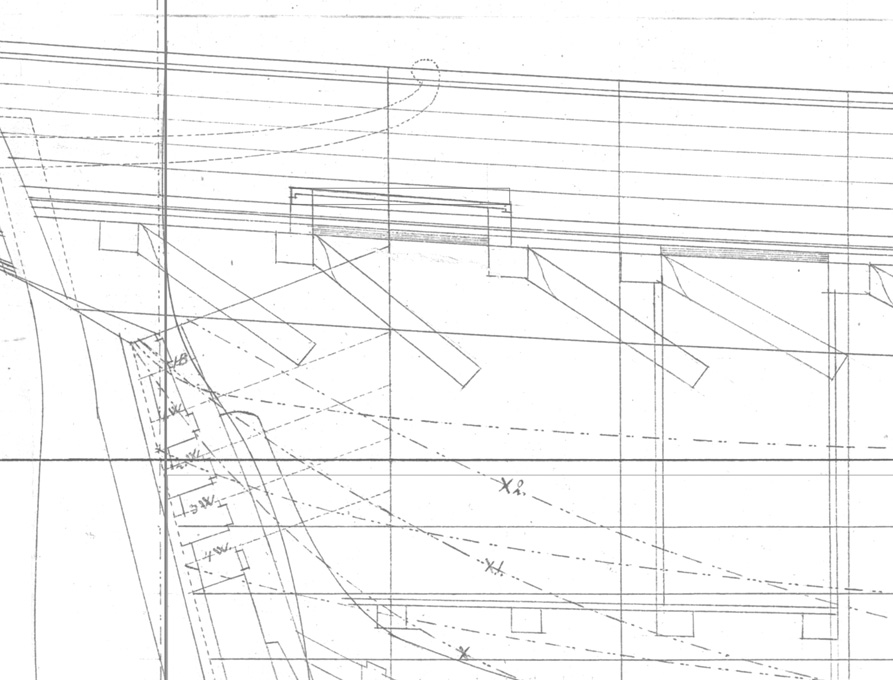
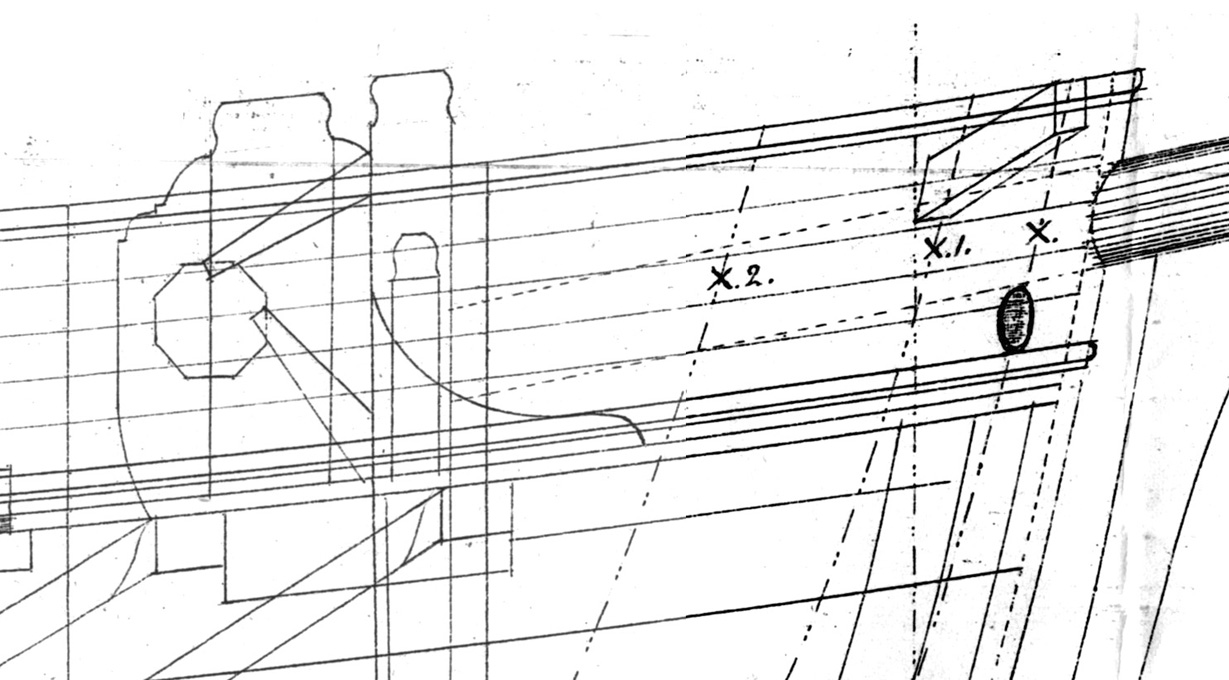
The original drawings comprise a sail-plan and a spar-list with dimensions, which is a good start. However, as this is the builder�s and not a modeller�s plan, there are no details on the actual execution of the rig. These have to be reconstructed from sources from around the middle of the 19th century, notably
BIDDLECOMBE, G. (1848): The Art of Rigging.- 155 p., Salem, Ma. (Reprint 1990 by Dover Publication, New York).
BOBRIK, E. (1848): Handbuch der praktischen Seefahrtskunde, Schiffgeb�udekunde, Zur�stungskunde, Man�vrierkunde, Ankerkunde, Tafeln zur Schifferkunde.- 604 p. + plates, Leipzig (reprint 1978 by Horst Hamecher, Kassel).
COST�, F.-A. (18292): Manuel de Gr�ement ou l�art d��quiper les vaisseaux et autres batimens de mer, de tout ce qui est n�cessaire a leurs mouvements.- 282 p., tables, Paris (Dezauche).
JA�, . (1860): �tudes sur le Gre�ment d�apr�s les r�glement du 25 avril 1857, r�vis� en 1858.- Atlas du G�nie Maritime, 2�me Serie, Annexe No. 1: 55 pl., Paris (Minist�re de la Marine et des Colonies).
KIPPING, R. (1853): Rudimentary Treatise on Masting, Mast-Making, and Rigging of Ships.- 150 p., London (John Weale).
MIDDENDORF, F.L. (1903): Bemastung und Takelung der Schiffe.- 401 p., Kassel (reprint 1977 by Horst Hamecher). � this is a bit late, but has useful tables with dimensions of parts
While these works contain many useful tables and sometimes beautiful detailed drawings, I realised that they are of limited use for this project as they mainly deal with larger ships. Only occasionally they give information on rigging practice for single-masted vessels. In some cases information on the foremast and bowsprit/jibboom of topsail-schooner was useful, as their rigging layout is similar.
The popular secondary literature on, e.g. British or French naval cutters, that have at a first glance a similar sail-plan, also is only of limited value, as they typically have a running bowsprit, and not a fixed one with jib-boom.
So, much had to be interpolated, also from secondary sources covering earlier or later periods.
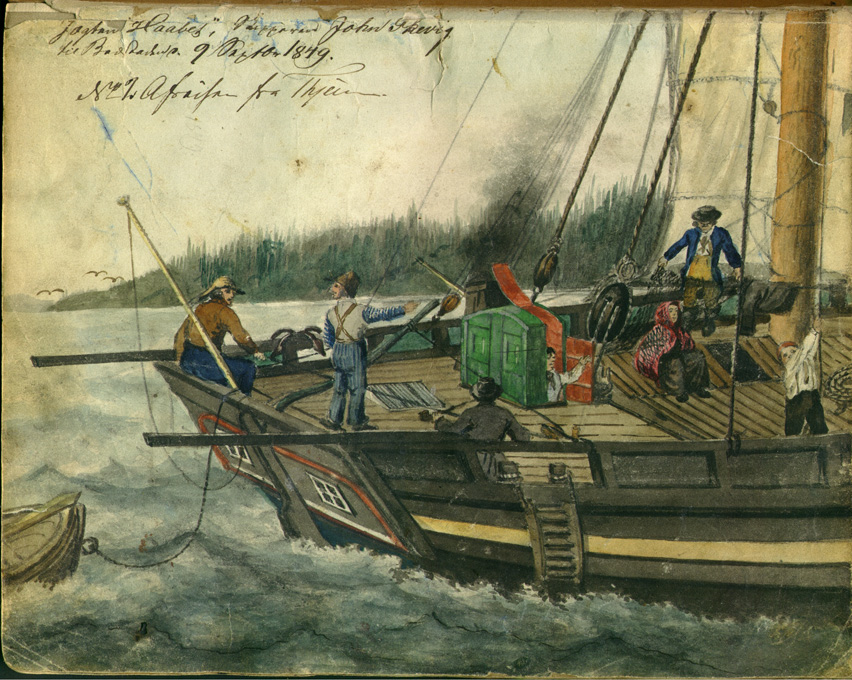
I also studied numerous images of German, Danish, Swedish, and Norwegian sloops operating in the Baltic with respect to the arrangement of stays, shrouds, backstays, topmast-shrouds, -stays, -backstays, and the bowsprit/jibboom. A considerable variability in layouts was observed.
Although the models of sloops and topsail-schooners in the Altona Museum (Hamburg) were built and rigged at the turn of the 19th to the 20th century, the model builders included older professional riggers, who presumably were aware of the earlier practices. These models give a good overview of the variability of rigging layouts and the supporting structures at the hull and on the deck.
With this information it has been possible to develop a draft warrant for the standing and (part of) the running that will help to dimension and locate the necessary pin-rails, rigging cleats, bollards, etc.
 Reconstructed dimensions for the standing rigging
 Reconstructed dimensions for (part of) the running rigging
To be continued �
Reconstructed dimensions for (part of) the running rigging
To be continued �