Charles,
A second try (I tried posting a long write-up and it disappeared). These images were posted about two years ago, but are still wonderful. I got curious as to the identity of the "Mystery Destroyer" that I went on a quest. I found an answer and worked up a draft article for Warship International, but the user fees that Getty-LIFE wanted to charge were way too much. Here is a shorted version of the article.
A series of images taken by the noted photographer, Dmitri Kessel, while he was onboard an unidentified destroyer as part of an Atlantic convoy heading for North Africa, that were posted on the Google-LIFE collection caught my eye and curiosity. The photos are not identified as to when they were taken or as to the mission/convoy involved. I really was curious about the GLEAVES class destroyer that most if not all of the photos had been taken from. This destroyer had an unusual configuration that I had not come across before at NARA or elsewhere. The ship had been modified for twin 40-mm mounts and Mk 51 directors, but had not been installed and two single 20-mm guns were installed in the bulwark tubs intended for the twin 40-mm mounts.
http://www.gstatic.com/hostedimg/9ac4d8e927ea849b_large

First off, I knew the destroyer was from one of the first group of GLEAVES class destroyers because of the canvas covered 53 mount and two quintuple torpedo tube mounts (see the images Charles posted). On this group of destroyers, the twin 40-mm mounts were not installed until late in 1942, many not until early 1943. Since, some of the photos in the series were taken in Casablanca harbor; they were taken after the invasion. One of the few ships that could be identified in the series of photos was the oiler USS Mattaponi (AO-41), which according to her DANFS entry said that she didn�t start convoy missions until mid-December 1942. Also, from the photos I have found at NARA in the BuShips files, the installation of the twin 40-mm mounts on GLEAVES class destroyers didn�t start until late November 1942. By deleting from my list the destroyers with two quintuple torpedo tube mounts from this early group that had either been lost or transferred to the Pacific, I had ten ships in a possible candidate list:
DD-429 Livermore
DD-430 Eberle
DD-432 Kearny
DD-437 Woolsey
DD-438 Ludlow
DD-439 Edison
DD-440 Ericsson
DD-441 Wilkes
DD-442 Nicholson
DD-443 Swanson
Another factor to consider was that the style of Mk 51 director platform seen on this mystery destroyer, an elevated platform immediately forward of the 40-mm mount, was an early style that was replaced with a different style in about April 1943. I knew that three of the above destroyers had this style of Mk 51 director platform and the twin 40-mm mounts installed by the end of December 1942. I decided that the most likely period for this convoy was early 1943.
My first effort at identifying this ship was to look at all the photos attributed to Dmitri Kessel in this series and attempt a cross reference. I found one destroyer that was identifiable; USS Wainwright (DD-419), which was a SIMS class destroyer that during the war was assigned as a DesDiv flag for BENHAM class and GLEAVES class destroyers. But, during much of the war, individual destroyers could be detached from their unit and tasked to escort with other destroyers in a convoy so it wouldn�t be unusual to see mixed ships. But, it was interesting that Wainwright had been rearmed with twin 40-mm mounts and appears to have the same style of elevated platform for the Mk 51 director.
Most of the other ships in the series were cargo ships or were too distant to identify which ship they were. I did note that there were two escort carriers without identifiable markings and they seemed to be in Royal Navy camouflage. I posted an inquiry on a ship modeling website forum with this photo and someone identified them as likely being HMS Stalker and HMS Hunter on their first cruise after they were delivered to the Royal Navy and prior to going to the UK for modification. Looking on line, I found that these two ships crossed the Atlantic as part of convoy UGF-6 departing the USA on 5 March 1943 and arriving on 16 March 1943 at Casablanca. These two ships departed Casablanca on 19 March for the UK. This narrowed down the potential dates of the photos quite a bit.
Using the month of March 1943 as the date of this convoy and the unique configuration of the mystery destroyer I was able to narrow down the possible candidate ships. In looking at the first photo above, I noticed several features to the ship that were not common on all of the ships with two quintuple torpedo tube mounts. The style of canvas cover on 53 mount was a flat-top style seen on only a few ships, the amidships 20-mm bulwark tubs have unique reinforcing ribs, and that elevated Mk 51 director platform. From the photos I had scanned of these ten candidate destroyers, I was able to eliminate all but three based on when they had the twin 40-mm mounts installed and those unique 20-mm tubs.
The remaining three destroyers were;
DD-437 Woolsey
DD-438 Ludlow
DD-442 Nicholson
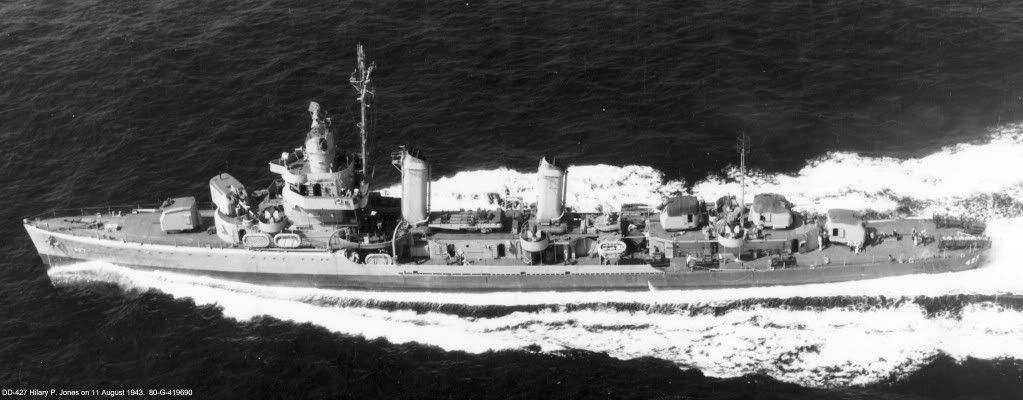
There were yard photos of Nicholson taken in April 1943. The particular photo below was taken from the same location at the back of the bridge as the first photo above taken by Dmitri Kessel. From this aspect the details are almost an exact match; the 53 mount and the 20-mm bulwark tub. The elevated Mk 51 director platform has been removed and the director relocated to the new inboard position. But, this was common on other units of this group in that period. The other two ships couldn�t be eliminated due to a lack of photographic evidence. So on to textual records.

On my next trip to NARA I looked into the War Diaries and BuShips records for most of these three ships and Wainwright. BuShips records eliminated Woolsey since her twin 40-mm mounts were installed at New York Navy Yard during availability 14-24 February 1943. Ludlow was damaged during the North Africa invasion by an approximate 6-in size shell and was repaired in late November-December 1943. But, I couldn�t find a Departure report or any document that specifically said that twin 40-mm mounts were installed or what work was done. Nicholson had an overhaul period at New York Navy Yard 11-20 January 1943. I found no Departure Report or other documentation on the work done to her during this availability except that she still had six 20-mm guns and no 40-mm guns. So, the April 1943 yard period likely was when she had the twin 40-mm mounts installed.
Wainwright records indicate that she received her twin 40-mm mounts in early December 1942. But, the War Diaries indicate that Wainwright and her DesDiv mates were assigned to escort convoy UGS-6 not UGF-6.
The War Diaries for Nicholson were enlightening to the whole story and provide the likely answer. Nicholson as part of DesRon 13 was assigned to convoy UGF-6 that departed 6 March 1943. Her War Diary does indicate that Mattaponi was part of UGF-6 as well. As convoy UGF-6 approached North Africa, the convoy split with Mattaponi and Brooklyn splitting off to meet another convoy ... UGS-6. Nicholson and DesRon 13 continued with the rest of the convoy to Casablanca arriving on 16 March. On 18 March Nicholson and Bristol (DD-453) were dispatched to meet convoy UGS-6 as reinforcements. Convoy UGS-6 was repeatedly attacked by U-Boats as they crossed the Atlantic and had lost four ships.
On 19 March, Nicholson came alongside Wainwright for instructions. Nicholson and Bristol continued with UGS-6 to Casablanca arriving on 21 March. DesRon 13 remained at Casablanca until 25 March when they departed with the westbound convoy CTF-64 which included Mattaponi. Nicholson went into New York Navy Yard as soon as she returned on 5 April.
I can�t be sure with absolute certainty, but I believe that the mystery destroyer is Nicholson. Ludlow is a possibility, but unlikely. An April 1943 photo of Ludlow has some of the features of the mystery destroyer and was part of convoy UGF-6 and in DesRon 13, but I found no connection to UGS-6 and Wainwright except in Casablanca harbor. At any rate these photos were taken during March 1943.


 ).
).