After looking at this site and a few others I've been thinking of building some of the WWI German Battle Cruisers ... such as Seydlitz and Derfflinger. It would seem that the only large scale models that are available are paper card ones. I'd like to build these models using plastic card, a material I'm more comfortable with.
Does anyone have experience in "transfering" the paper model version to plastic card - if so, any pointers???
Thanks in advance!
Paper card model transfered to plastic?
Moderator: JIM BAUMANN
-
Nailcreek
- Posts: 1
- Joined: Sun Apr 16, 2006 2:08 pm
- Location: Wausau, WI
-
treadhead1952

- Posts: 36
- Joined: Wed Jun 21, 2006 7:21 pm
- Location: Las Vegas, NV
- Contact:
I have done a few subjects, Naval and otherwise, using Cardmodel kits as the blueprint so to speak. I found an Admirable Class Minesweeper paper model planset on the Digital Navy site available as a sample for a free download and it worked out pretty well.
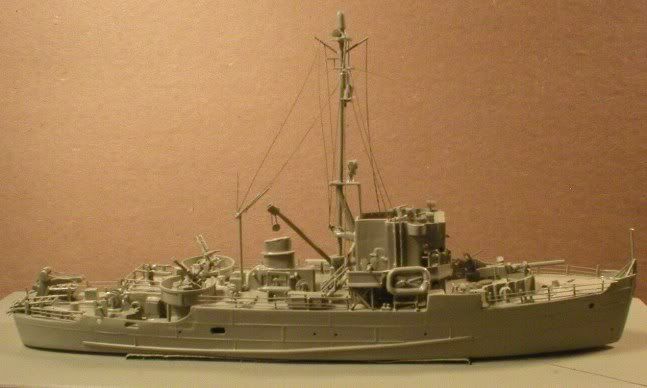
The finished model in 1/250 scale works out to about 8 and a half inches long and large enough to support a lot of detailing. I have also done planes, vehicles and such, doing much the same thing. The use of styrene makes building in contours and complex shapes a lot easier and more three dimensional than the original paper. You can also blow up the paper parts to larger scales if that is what you are after as well. A copier with percentage expansion feature makes this very easy barring the use of complex computer software.
Paper Models are very popular in Europe and Asia and they have tons of subjects to whet your appetite. You can find the books, that is how most of them come, sort of like a magazine with punchout parts, at a number of places here in the States, there are also CD's available with lots of different subjects that you can just print out and go to work on from there.
As to tips, select the subject of choice and start cutting. A nice sharp #11 blade works but a pair of scissors will do the job as well. You can attach the paper parts to sheet styrene using plain old rubber cement to add the cutout shapes to a sheet of styrene to cut down on waste as you go. If you use scissors be prepared to do some sanding to the edges to smooth things out, sanding sticks work well, you can pick up fingernail sanding sticks at cosmetic aisles in most stores, a much cheaper alternative to the more expensive ones in hobby shops. To enable you to follow the complex shapes of some hulls, I have found that making multiple copies of the outside shape in thin styrene sheet to glue to the formers once you have them assembled and then laying one sheet over another gives you the required thickness to keep from flexing or wrinkling while being able to replicate the complex curves. You can use thin stretched sprue to add the weld seams to replicate those details. Styrene shapes as well as sheet helps when making up the details, a trip to the local Hobby Shop should offer you lots of material. Brass sheet can also be uses as well as copper wire in various thicknesses. Radio Shack is a good choice for copper wire in different sizes, a set of four sizes on small spools sells for less than $5 and lasts for some time. Hope all this helps and I look forward to seeing your creations.
I am currently working on the USS Ward in 1/400 scale as a long term project, it is being built up in its' APD configuration, but since I have the original plans, making up earlier versions or any of a number of the Wickes class of ships is quite within the realm of possibilites, all that is required is time and patience. The Wickes Class were the type that the US lend leased to the Royal Navy at the beginning of WWII, as such you could have more than just the US types.
The finished model in 1/250 scale works out to about 8 and a half inches long and large enough to support a lot of detailing. I have also done planes, vehicles and such, doing much the same thing. The use of styrene makes building in contours and complex shapes a lot easier and more three dimensional than the original paper. You can also blow up the paper parts to larger scales if that is what you are after as well. A copier with percentage expansion feature makes this very easy barring the use of complex computer software.
Paper Models are very popular in Europe and Asia and they have tons of subjects to whet your appetite. You can find the books, that is how most of them come, sort of like a magazine with punchout parts, at a number of places here in the States, there are also CD's available with lots of different subjects that you can just print out and go to work on from there.
As to tips, select the subject of choice and start cutting. A nice sharp #11 blade works but a pair of scissors will do the job as well. You can attach the paper parts to sheet styrene using plain old rubber cement to add the cutout shapes to a sheet of styrene to cut down on waste as you go. If you use scissors be prepared to do some sanding to the edges to smooth things out, sanding sticks work well, you can pick up fingernail sanding sticks at cosmetic aisles in most stores, a much cheaper alternative to the more expensive ones in hobby shops. To enable you to follow the complex shapes of some hulls, I have found that making multiple copies of the outside shape in thin styrene sheet to glue to the formers once you have them assembled and then laying one sheet over another gives you the required thickness to keep from flexing or wrinkling while being able to replicate the complex curves. You can use thin stretched sprue to add the weld seams to replicate those details. Styrene shapes as well as sheet helps when making up the details, a trip to the local Hobby Shop should offer you lots of material. Brass sheet can also be uses as well as copper wire in various thicknesses. Radio Shack is a good choice for copper wire in different sizes, a set of four sizes on small spools sells for less than $5 and lasts for some time. Hope all this helps and I look forward to seeing your creations.
I am currently working on the USS Ward in 1/400 scale as a long term project, it is being built up in its' APD configuration, but since I have the original plans, making up earlier versions or any of a number of the Wickes class of ships is quite within the realm of possibilites, all that is required is time and patience. The Wickes Class were the type that the US lend leased to the Royal Navy at the beginning of WWII, as such you could have more than just the US types.
Last edited by treadhead1952 on Wed Jun 28, 2006 1:40 pm, edited 1 time in total.
Jay Massey
treadhead1952
Las Vegas, NV
treadhead1952
Las Vegas, NV
-
Francis Macnaughton
Printing to plastic card
Tim Perry explained how items can be printed using a standard printer on reasonably thin plastic card at his Kipperboxes web site:
http://www.kipperboxes.co.uk/html/lct_mk_4.html
but note his warning about laser printers!
Francis Macnaughton
http://www.kipperboxes.co.uk/html/lct_mk_4.html
but note his warning about laser printers!
Francis Macnaughton