Pomeranian Rahschlup 1846 � 1/160 scale � Baltic trader
Moderators: MartinJQuinn, JIM BAUMANN, HMAS, Tiny69, Dave Wooley
-
Pieter
- Posts: 1608
- Joined: Sat Sep 17, 2005 9:19 am
Re: Pomeranian Rahschlup 1846 � 1/160 scale � Baltic trader
Nice paint work. About acrylic paint drying too fast, all marks of acrylic paint offer a 'retarder' that makes the paint dry slower without attacking the piant layer below it. Acrylic 'thinners' do attack older paint layers which can be useful sometimes, for weathering for example or for doing carrier decks. I used acrylic thinner on my HMS Glory.
-
wefalck

- Posts: 2118
- Joined: Wed Sep 28, 2011 12:04 pm
- Location: Paris
- Contact:
Re: Pomeranian Rahschlup 1846 � 1/160 scale � Baltic trader
Thanks, I am aware of 'retarders', but I have actually never used them, as the fast drying in most cases is a desirable property.
The Vallejo and Schmincke acrylics that I am using just require water for thinning. Other brands may use a mixture of water and alcohol as solvents and then one can use alcohol for thinning. Using an incompatable solvent for thinning can lead to a breakdown of the acrylic emulsions and coagulation. Acrylics using alcohol as solvent are likely to dry even faster.
The Vallejo and Schmincke acrylics that I am using just require water for thinning. Other brands may use a mixture of water and alcohol as solvents and then one can use alcohol for thinning. Using an incompatable solvent for thinning can lead to a breakdown of the acrylic emulsions and coagulation. Acrylics using alcohol as solvent are likely to dry even faster.
Eberhard
Former chairman Arbeitskreis historischer Schiffbau e.V. (German Association for Shipbuilding History)
--------------------------------------------------------------------------------------------------------------------------------------------------------------------------------------------




Former chairman Arbeitskreis historischer Schiffbau e.V. (German Association for Shipbuilding History)
--------------------------------------------------------------------------------------------------------------------------------------------------------------------------------------------
-
marijn van gils
- Posts: 2707
- Joined: Tue Feb 06, 2007 10:24 am
- Location: Belgium
Re: Pomeranian Rahschlup 1846 � 1/160 scale � Baltic trader
Great job on the paintwork Eberhart! Especially the striping; not easy in this scale... 
Another paint type that I find very useful for brush-applied basecoats that need adjusting (like the stripes or the stern carvings) is enamel. I always liked Humbroll, but with all the formula changes I prefer Revell nowadays.
Just like gouache, it can be removed or 'pushed around' with a damp brush (but white spirit instead of water of course) after application. But not forever like gouache, so it is best to apply a small area, adjust with the damp brush, paint the next area etc.
The main advantages over gouache: it is waterproof, so it doesn't need a protective coat, and it is easier to obtain a smooth surface.
I have also found that for detail painting, one of the most important factors is the quality of the brush. So far, I haven't found anything better than the Winsor & Newton series 7. Expensive, but such a joy to paint with...
When applying thin and long decals, it can help to cut them in shorter sections and apply those one at a time. Of course, that can make it a bit more difficult to make the line perfectly follow the curve of the sheerline without any minor kinks, which is really important for these lines.
I'm looking forward to the next steps!
Another paint type that I find very useful for brush-applied basecoats that need adjusting (like the stripes or the stern carvings) is enamel. I always liked Humbroll, but with all the formula changes I prefer Revell nowadays.
Just like gouache, it can be removed or 'pushed around' with a damp brush (but white spirit instead of water of course) after application. But not forever like gouache, so it is best to apply a small area, adjust with the damp brush, paint the next area etc.
The main advantages over gouache: it is waterproof, so it doesn't need a protective coat, and it is easier to obtain a smooth surface.
I have also found that for detail painting, one of the most important factors is the quality of the brush. So far, I haven't found anything better than the Winsor & Newton series 7. Expensive, but such a joy to paint with...
When applying thin and long decals, it can help to cut them in shorter sections and apply those one at a time. Of course, that can make it a bit more difficult to make the line perfectly follow the curve of the sheerline without any minor kinks, which is really important for these lines.
I'm looking forward to the next steps!
-
wefalck
- Posts: 2118
- Joined: Wed Sep 28, 2011 12:04 pm
- Location: Paris
- Contact:
Re: Pomeranian Rahschlup 1846 � 1/160 scale � Baltic trader
Thanks, Marijn,
Indeed, enamels would have been an option, I still have a box full of decade old Humbrol tins. As I always stored them upside-down, they may be still good. However, I never liked the mess of cleaning brushes with them too much, even though I discovered early on in my life, that washing powder meant for wool (the German 'Rei') works very well and saves on expensive thinners.
The other option I had in the back of my mind was oils, but their long drying times is a drawback, also it can be shortened by using turpentine instead of lineseed oil as medium.
Good brushes help indeed. Unfortunately, sable-brushes are ruined quite quickly by acrylics and are not recommended. I usually use the Da Vinci brand synthetics. Buying brushes is another matter. Even in shops one often finds that they are already damaged.
Indeed, enamels would have been an option, I still have a box full of decade old Humbrol tins. As I always stored them upside-down, they may be still good. However, I never liked the mess of cleaning brushes with them too much, even though I discovered early on in my life, that washing powder meant for wool (the German 'Rei') works very well and saves on expensive thinners.
The other option I had in the back of my mind was oils, but their long drying times is a drawback, also it can be shortened by using turpentine instead of lineseed oil as medium.
Good brushes help indeed. Unfortunately, sable-brushes are ruined quite quickly by acrylics and are not recommended. I usually use the Da Vinci brand synthetics. Buying brushes is another matter. Even in shops one often finds that they are already damaged.
Eberhard
Former chairman Arbeitskreis historischer Schiffbau e.V. (German Association for Shipbuilding History)
--------------------------------------------------------------------------------------------------------------------------------------------------------------------------------------------
Former chairman Arbeitskreis historischer Schiffbau e.V. (German Association for Shipbuilding History)
--------------------------------------------------------------------------------------------------------------------------------------------------------------------------------------------
-
JIM BAUMANN

- Posts: 5689
- Joined: Mon Jan 10, 2005 5:30 pm
- Location: Nr Southampton England
Re: Pomeranian Rahschlup 1846 � 1/160 scale � Baltic trader
ahoi wefalck
Looking nice!-- I also loathe masking for its--in my hands anyhow--lack of precision !
I think you may obtain a sharper definition / demarcation of the white lines using thin decal striping
images below are from the 170 mm loa model of 1891 HMS Hood
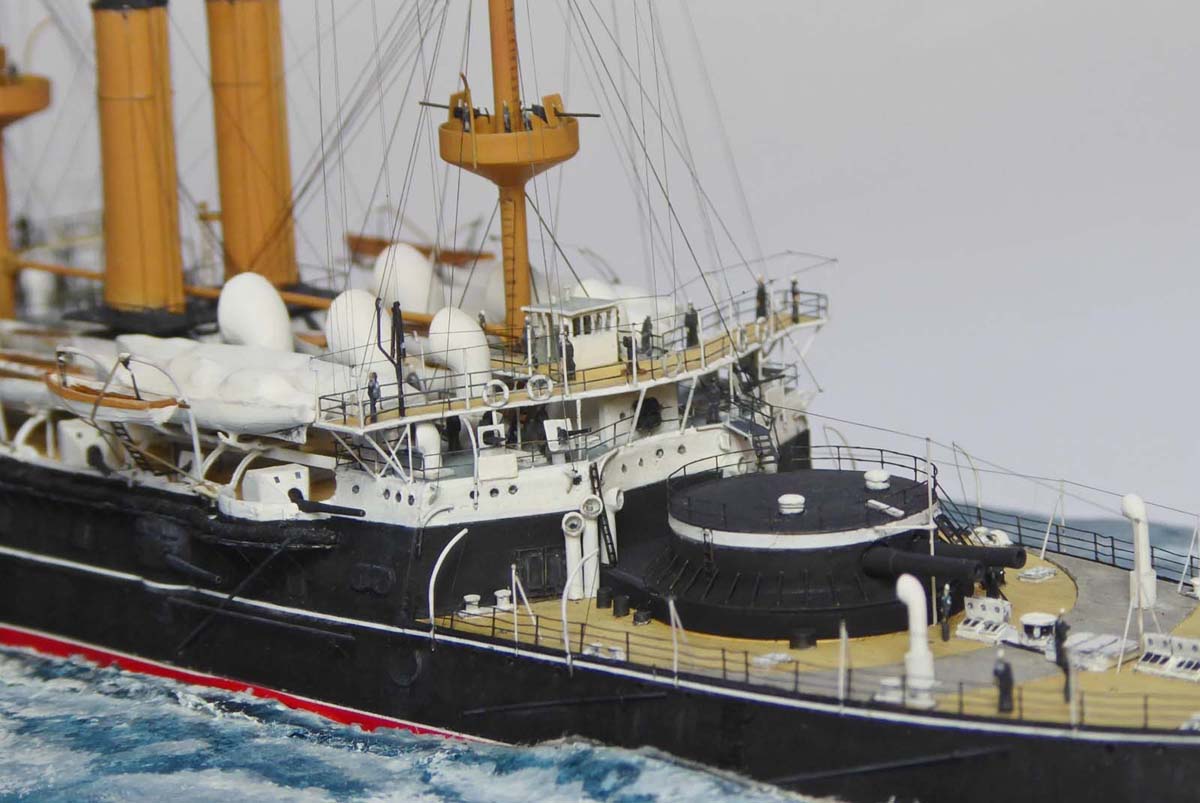

Looking nice!-- I also loathe masking for its--in my hands anyhow--lack of precision !
I think you may obtain a sharper definition / demarcation of the white lines using thin decal striping
images below are from the 170 mm loa model of 1891 HMS Hood
....I buy them at three times the speed I build 'em.... will I live long enough to empty my stash...?
http://www.modelshipgallery.com/gallery ... index.html
IPMS UK SIG (special interest group) www.finewaterline.com
http://www.modelshipgallery.com/gallery ... index.html
IPMS UK SIG (special interest group) www.finewaterline.com
-
wefalck
- Posts: 2118
- Joined: Wed Sep 28, 2011 12:04 pm
- Location: Paris
- Contact:
Re: Pomeranian Rahschlup 1846 � 1/160 scale � Baltic trader
Jim, I would have indeed used decal strips (as I did on SMS WESPE), if the colour didn't need to go around the edge of the wale. OK, perhaps a white decal strip and then painting over it and the edge ... I could still do that.
Eberhard
Former chairman Arbeitskreis historischer Schiffbau e.V. (German Association for Shipbuilding History)
--------------------------------------------------------------------------------------------------------------------------------------------------------------------------------------------
Former chairman Arbeitskreis historischer Schiffbau e.V. (German Association for Shipbuilding History)
--------------------------------------------------------------------------------------------------------------------------------------------------------------------------------------------
-
wefalck
- Posts: 2118
- Joined: Wed Sep 28, 2011 12:04 pm
- Location: Paris
- Contact:
Re: Pomeranian Rahschlup 1846 � 1/160 scale � Baltic trader
Some more deck details
There were some deck details of which the location puzzled me a bit. These included the down-pipes into the chain-locker for the anchor-chains (to be discussed later), the chimney(s) for the stove(s) in the crew- and captain’s quarters, the mandatory drinking-water barrel, and to some extent the bilge-pump (also to be discussed later).
Chimney
By the middle of the 19th century small cast-iron stoves were in common use on ships like the Rahschlup. Looking at illustrations of the time, the more traditional square, sheet-metal lined wooden chimneys were gradually replaced by round sheet-metal stove pipes. The chimney could be removed and the passage through the deck closed with a cap, so that they would not get in the way when handling the anchors or sails.
I found a good image in my collection of a model of a Jagt in the Museet for Søfart in Helsingør/Danmark, that shows exactly the sort of arrangement that I had in mind.
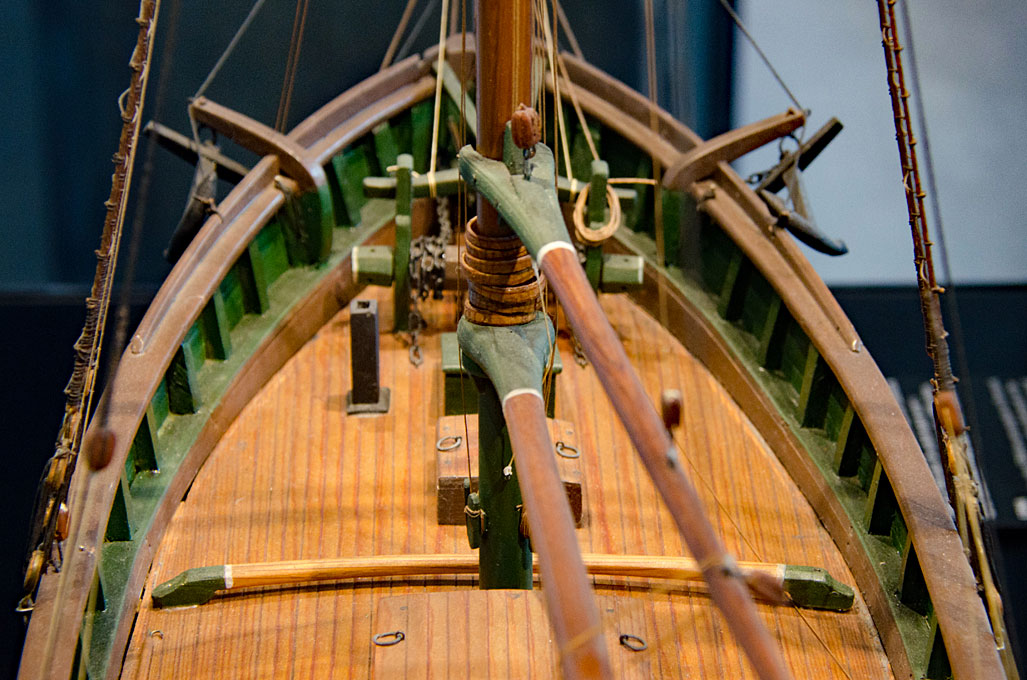
Model of a Jagt in the Museet for Søfart in Helsingør/Danmark
Perhaps the best illustration of the interior arrangement is that of ‘Caboteur Danois’, i.e. a Danish ‘jagt’, from Paris’ ‘Souvenirs de la Marine’ (Planche 213). It gives even more details than the drawings for DE FIRE BRØDERE and CASTOR from Nielsen‘s ‚Danske Bådtyper‘.
According to this the stove in the crew quarters is placed next to the access ladder, at the rear bulkhead, while the placement of the one in the captain’s quarters depends on the layout of that cabin. Again, it is likely placed against the forward bulkhead.
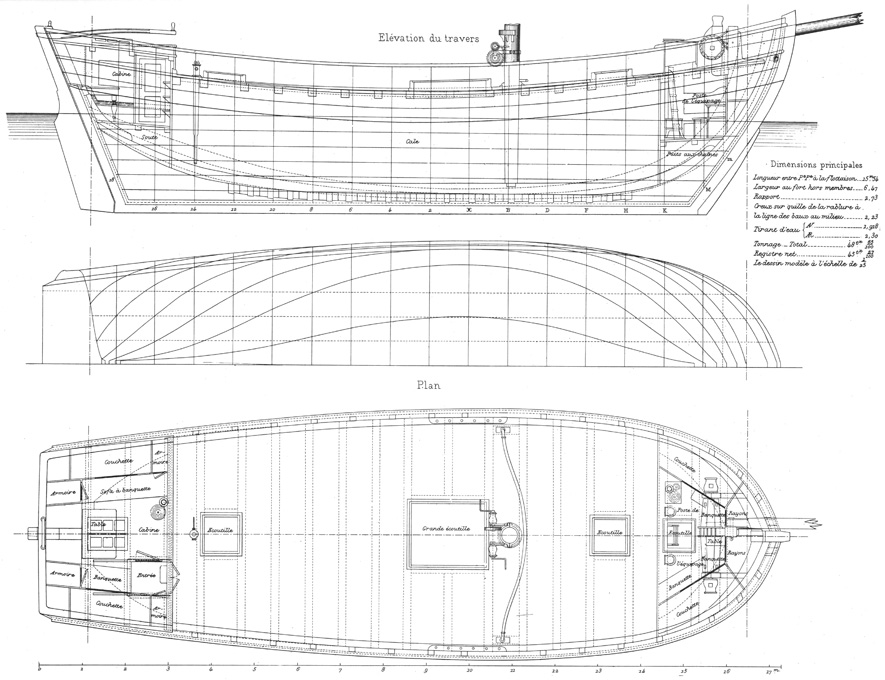
Caboteur Danois (jagt), Pl. 213 of the Souvenirs de la Marine by E. de Pâris
As the model will be shown moored alongside a quay, the chimney will be rigged and will be placed on the port side of the crew companionway. Although, I envisage a summer setting, it is shown, because the stove would have been used for cooking as well.
I am not sure, where the stove for the main cabin would have been placed, but I am showing it as closed with a cap on the port side of the companionway.
The forward chimney was milled from a piece of 2 mm x 2 mm polystyrene rod with the base as a separate piece cut from 1 nm x 3.2 mm polystyrene.
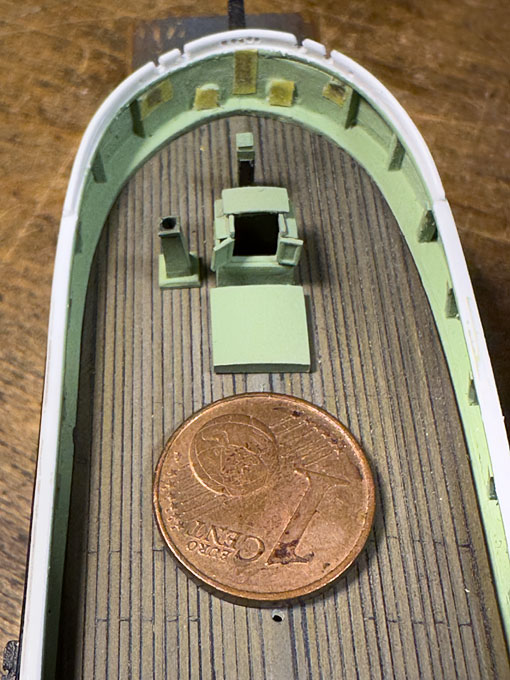
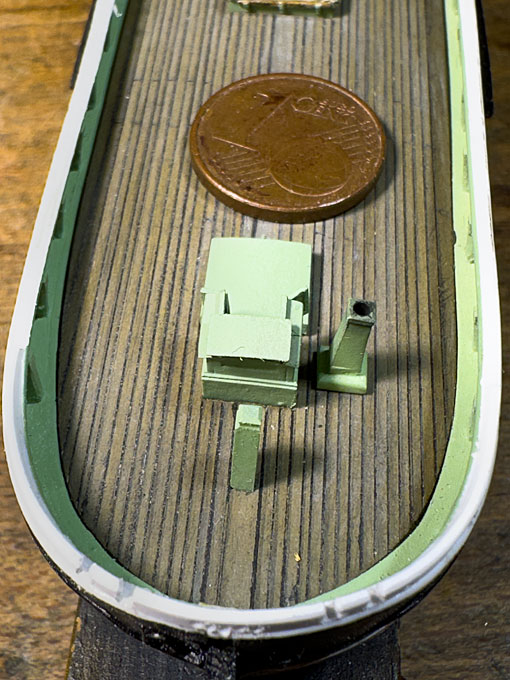
Drinking-water barrel
According to pictorial evidence, the placement of the barrel was quite variable, probably at a place where it did not get in the way of the operation of the ship and where it was somewhat protected. Often it was placed near the bulwark or near a companionway. As there is quite a distance between the main cabin companionway and the main hatch, I put it in front of the companionway.
The barrel was turned from a length of 4 mm acrylic rod, giving a barrel of of about 60 cm diameter, which appeared about right according to photographs of the time. With a length of about 5 mm (= 80 cm) such a barrel would hold about 200 l, which should be sufficient for a few days for a crew of 5 to 6.
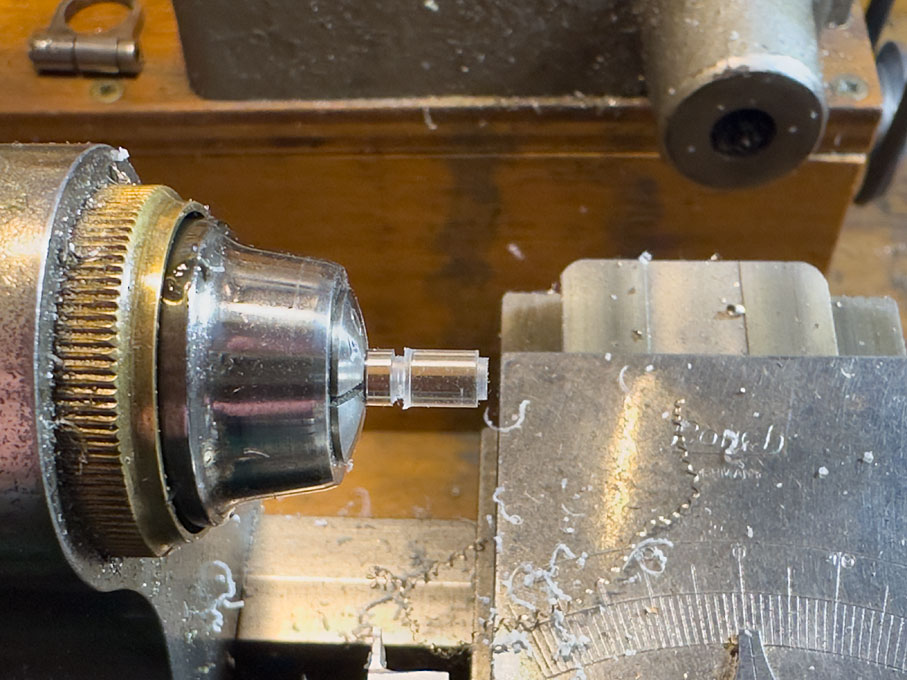
Determining the overall dimensions of the barrel
The curvature of the barrel was turned with the help of the radius turning attachment I made some years ago, held in the quick-change tool-post (QCTP). The geometries were worked out on my CAD software, i.e. the radius of the curvature was set to 9 mm and the minimum diameter would be 3 mm. Accordingly, a step with 3 mm diameter was turned on each side of the blank and then the attachment set to the middle of the future barrel. The whole radius turning tool was lowered in steps until the tool arrived at the minimum diameter.
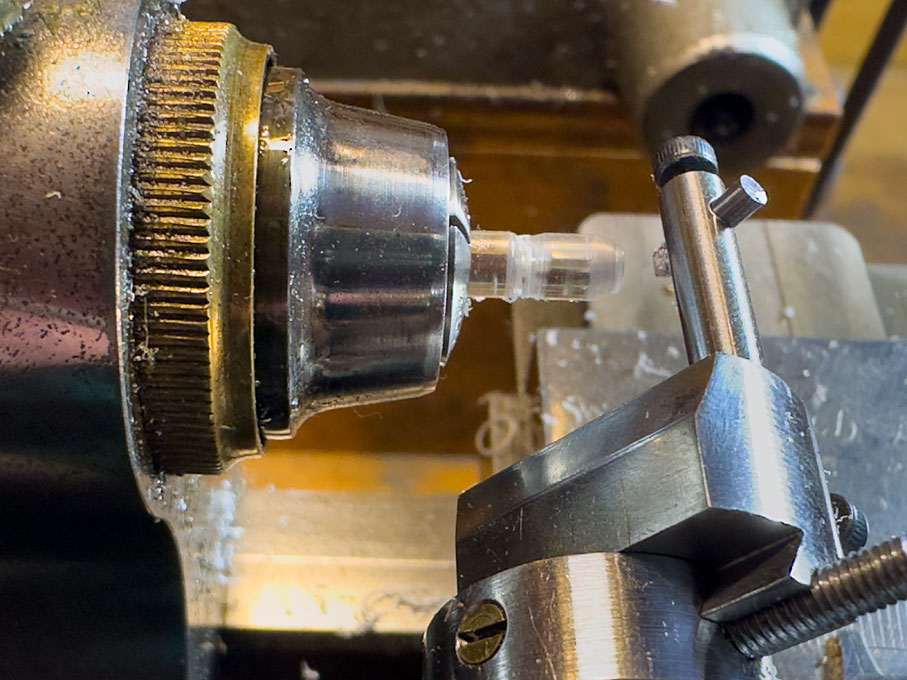
Initial steps of turning the curvature with the radius turning tool
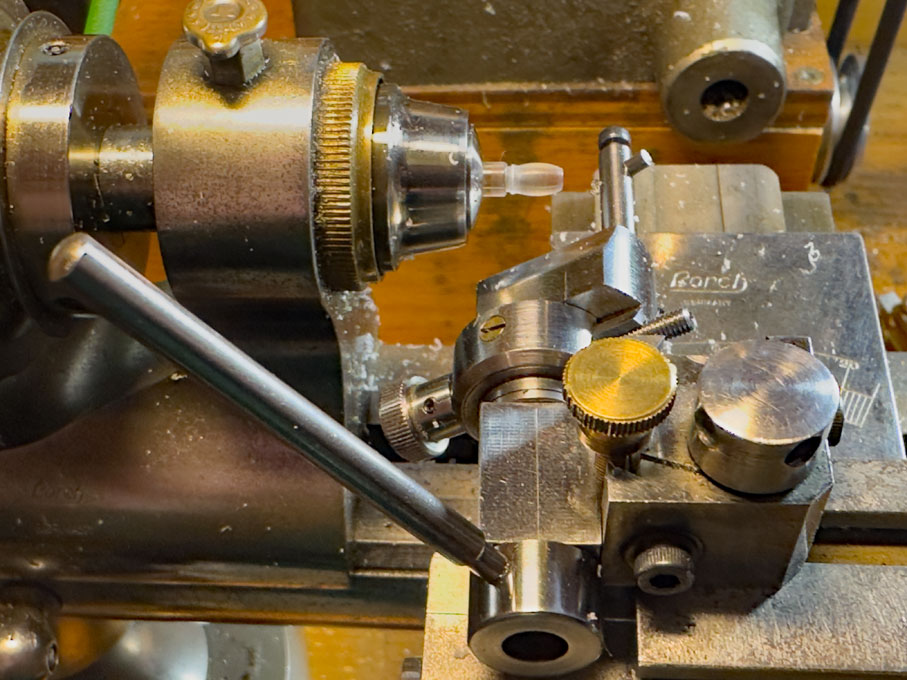
Final shape of the barrel
Without changing any other settings, the cutting tool was turned by 90° so that it cut lengthwise. The radius now was reduced by 0.1 mm to lightly engrave the staves. An Internet-consultation revealed that the staves should be about 10 cm wide at the large circumference. For a 60 cm diameter barrel this results in about 20 staves. Using the built-in dividing disc of the watchmakers lathe these 20 staves were engraved one by one.
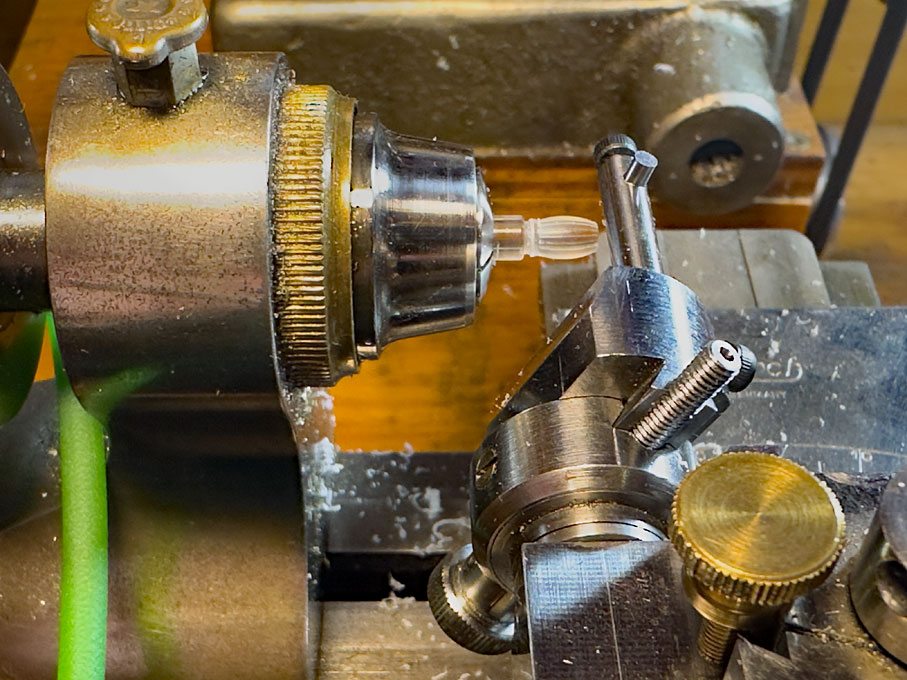
Engraving the staves
The recesses for the lids were simply cut with an end-mill that cuts over the centre. Holding the barrel once it has been parted off the stock was a bit tricky, but the watchmakers’ collets pinch at the front, so that even bulbous parts can be held for light operations.
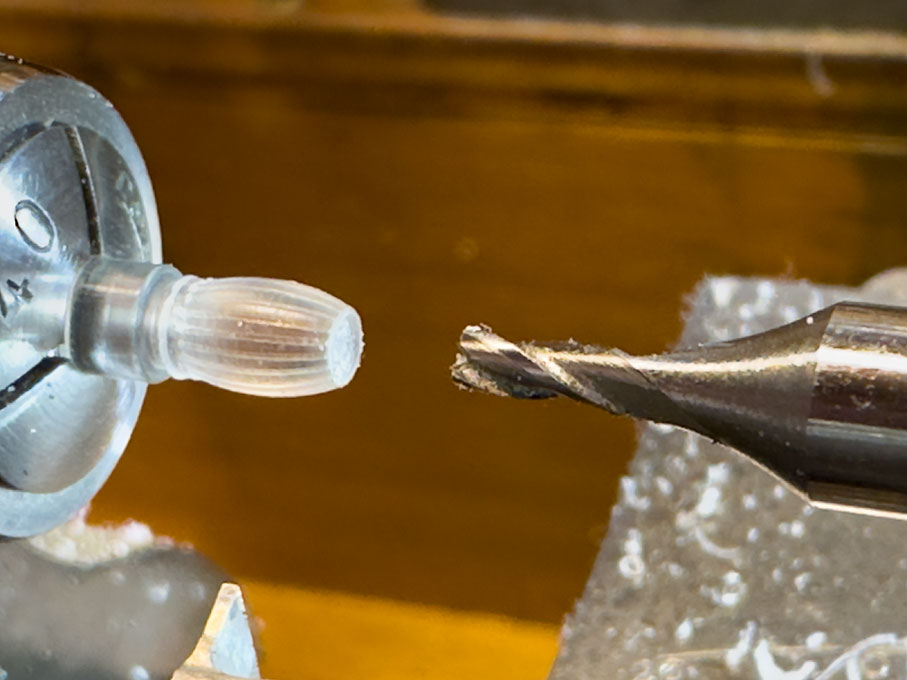
Cutting the recesses for the lids
The cradle was fabricated from tiny pieces of various polystyrene profiles.
Barrel and cradle were given a base-coat of the same green as the other deck furniture. The barrel-hoops and the retaining straps are thin pre-painted strips of paper.
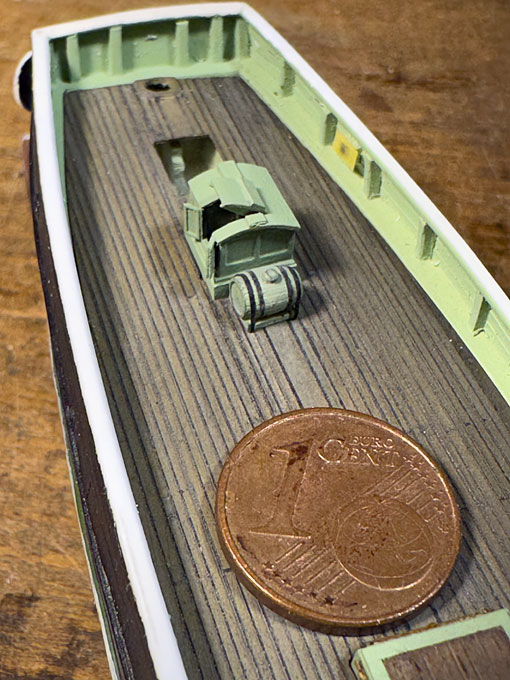
The painted water barrel at its future location
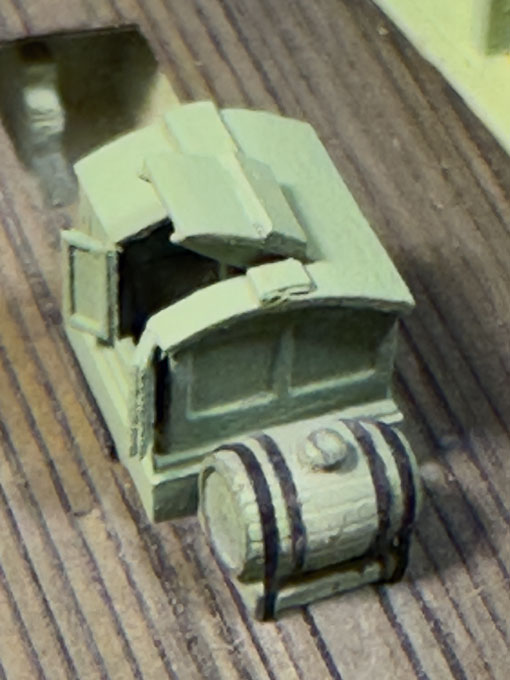
… and a horribly sobering close-up shot of the water barrel
To be continued …
There were some deck details of which the location puzzled me a bit. These included the down-pipes into the chain-locker for the anchor-chains (to be discussed later), the chimney(s) for the stove(s) in the crew- and captain’s quarters, the mandatory drinking-water barrel, and to some extent the bilge-pump (also to be discussed later).
Chimney
By the middle of the 19th century small cast-iron stoves were in common use on ships like the Rahschlup. Looking at illustrations of the time, the more traditional square, sheet-metal lined wooden chimneys were gradually replaced by round sheet-metal stove pipes. The chimney could be removed and the passage through the deck closed with a cap, so that they would not get in the way when handling the anchors or sails.
I found a good image in my collection of a model of a Jagt in the Museet for Søfart in Helsingør/Danmark, that shows exactly the sort of arrangement that I had in mind.
Model of a Jagt in the Museet for Søfart in Helsingør/Danmark
Perhaps the best illustration of the interior arrangement is that of ‘Caboteur Danois’, i.e. a Danish ‘jagt’, from Paris’ ‘Souvenirs de la Marine’ (Planche 213). It gives even more details than the drawings for DE FIRE BRØDERE and CASTOR from Nielsen‘s ‚Danske Bådtyper‘.
According to this the stove in the crew quarters is placed next to the access ladder, at the rear bulkhead, while the placement of the one in the captain’s quarters depends on the layout of that cabin. Again, it is likely placed against the forward bulkhead.
Caboteur Danois (jagt), Pl. 213 of the Souvenirs de la Marine by E. de Pâris
As the model will be shown moored alongside a quay, the chimney will be rigged and will be placed on the port side of the crew companionway. Although, I envisage a summer setting, it is shown, because the stove would have been used for cooking as well.
I am not sure, where the stove for the main cabin would have been placed, but I am showing it as closed with a cap on the port side of the companionway.
The forward chimney was milled from a piece of 2 mm x 2 mm polystyrene rod with the base as a separate piece cut from 1 nm x 3.2 mm polystyrene.
Drinking-water barrel
According to pictorial evidence, the placement of the barrel was quite variable, probably at a place where it did not get in the way of the operation of the ship and where it was somewhat protected. Often it was placed near the bulwark or near a companionway. As there is quite a distance between the main cabin companionway and the main hatch, I put it in front of the companionway.
The barrel was turned from a length of 4 mm acrylic rod, giving a barrel of of about 60 cm diameter, which appeared about right according to photographs of the time. With a length of about 5 mm (= 80 cm) such a barrel would hold about 200 l, which should be sufficient for a few days for a crew of 5 to 6.
Determining the overall dimensions of the barrel
The curvature of the barrel was turned with the help of the radius turning attachment I made some years ago, held in the quick-change tool-post (QCTP). The geometries were worked out on my CAD software, i.e. the radius of the curvature was set to 9 mm and the minimum diameter would be 3 mm. Accordingly, a step with 3 mm diameter was turned on each side of the blank and then the attachment set to the middle of the future barrel. The whole radius turning tool was lowered in steps until the tool arrived at the minimum diameter.
Initial steps of turning the curvature with the radius turning tool
Final shape of the barrel
Without changing any other settings, the cutting tool was turned by 90° so that it cut lengthwise. The radius now was reduced by 0.1 mm to lightly engrave the staves. An Internet-consultation revealed that the staves should be about 10 cm wide at the large circumference. For a 60 cm diameter barrel this results in about 20 staves. Using the built-in dividing disc of the watchmakers lathe these 20 staves were engraved one by one.
Engraving the staves
The recesses for the lids were simply cut with an end-mill that cuts over the centre. Holding the barrel once it has been parted off the stock was a bit tricky, but the watchmakers’ collets pinch at the front, so that even bulbous parts can be held for light operations.
Cutting the recesses for the lids
The cradle was fabricated from tiny pieces of various polystyrene profiles.
Barrel and cradle were given a base-coat of the same green as the other deck furniture. The barrel-hoops and the retaining straps are thin pre-painted strips of paper.
The painted water barrel at its future location
… and a horribly sobering close-up shot of the water barrel
To be continued …
Eberhard
Former chairman Arbeitskreis historischer Schiffbau e.V. (German Association for Shipbuilding History)
--------------------------------------------------------------------------------------------------------------------------------------------------------------------------------------------
Former chairman Arbeitskreis historischer Schiffbau e.V. (German Association for Shipbuilding History)
--------------------------------------------------------------------------------------------------------------------------------------------------------------------------------------------
-
DrPR

- Posts: 1689
- Joined: Sun Mar 07, 2010 12:01 am
- Location: Corvallis, Oregon, USA
- Contact:
Re: Pomeranian Rahschlup 1846 � 1/160 scale � Baltic trader
Eberhard,
I make close up macro photos of my modeling work, and parts that look very nice at arm's length show huge imperfections in the photos! But on the completed model these flaws just aren't noticeable.
Nice work on the barrel. Again, I have tool envy seeing what you do with your watchmaker's lathe.
I make close up macro photos of my modeling work, and parts that look very nice at arm's length show huge imperfections in the photos! But on the completed model these flaws just aren't noticeable.
Nice work on the barrel. Again, I have tool envy seeing what you do with your watchmaker's lathe.
A collision at sea will ruin your entire day. Aristotle
-
EJFoeth
- Posts: 2924
- Joined: Wed Jan 21, 2009 1:51 pm
Re: Pomeranian Rahschlup 1846 � 1/160 scale � Baltic trader
That is a very nice barrel!! Very interesting to see how it was made.
-
wefalck
- Posts: 2118
- Joined: Wed Sep 28, 2011 12:04 pm
- Location: Paris
- Contact:
Re: Pomeranian Rahschlup 1846 � 1/160 scale � Baltic trader
A sign of Life from the Shipyard
The last few weeks since the posting at the end of April have been crazy with travelling. I have been two weeks to Switzerland, a week to Denmark, and another week in Spain, mainly for business reasons.
I extended that business-trip to Copenhagen by a few days in order to re-visit a few museums in and around the city, including the M/S Museet for Søfart in Helsingør, the Vikingeskibs Museet in Roskilde, and the Krigsmuseet in Copenhagen that now houses the naval collection from the Holmen.
It being the long Pentecost-weekend, there turned out to be a sailing ship gathering in the harbour of Helsingør in front of the Kronborg Castle (of Hamlet’s fame). Among the various schooners, galiots, and smacks (jagts) there was also JENSINE af HADERSLEV (https://www.jensine.dk), a Danish jagt originally built in 1852, so more or less contemporary with the Rahschlup. She has the kind of livery that I have chosen for my project.
Unfortunately, JENSINE was sort of parked in third row, so I could get close to her. However, there are a few shots from this event below.
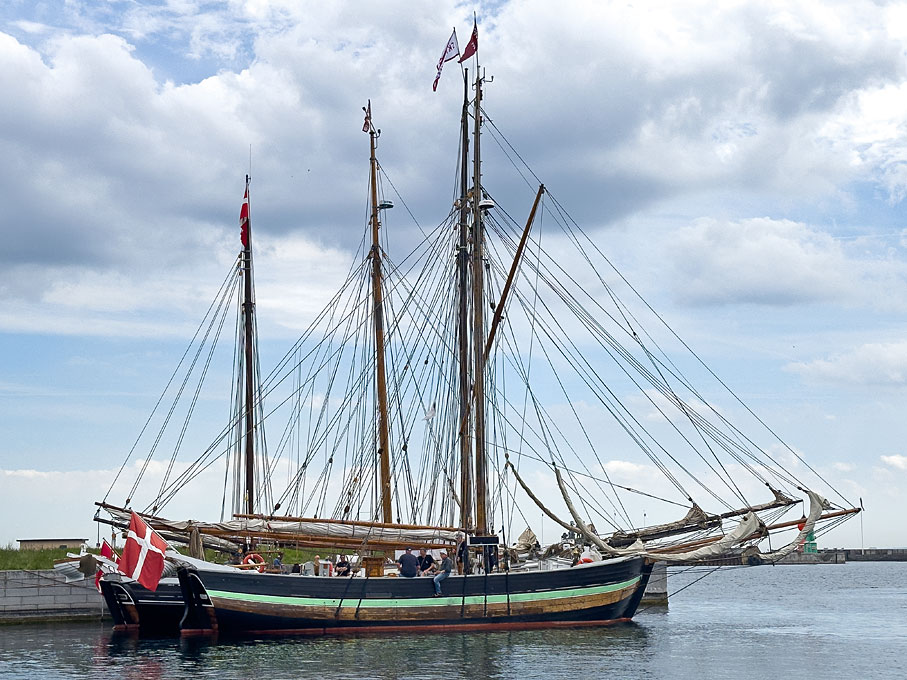
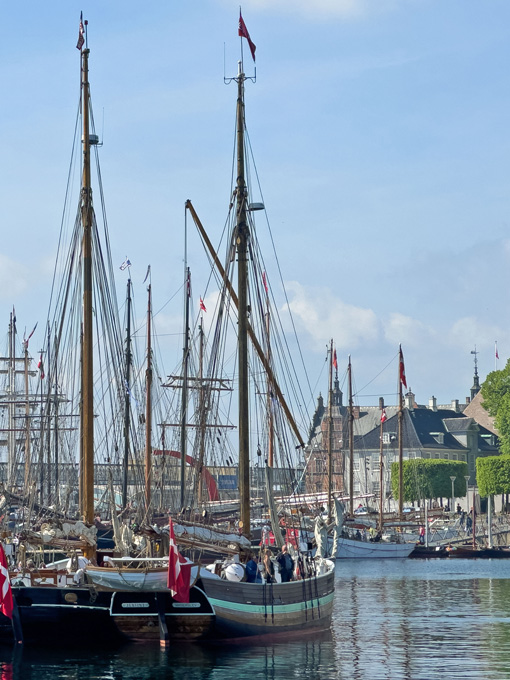
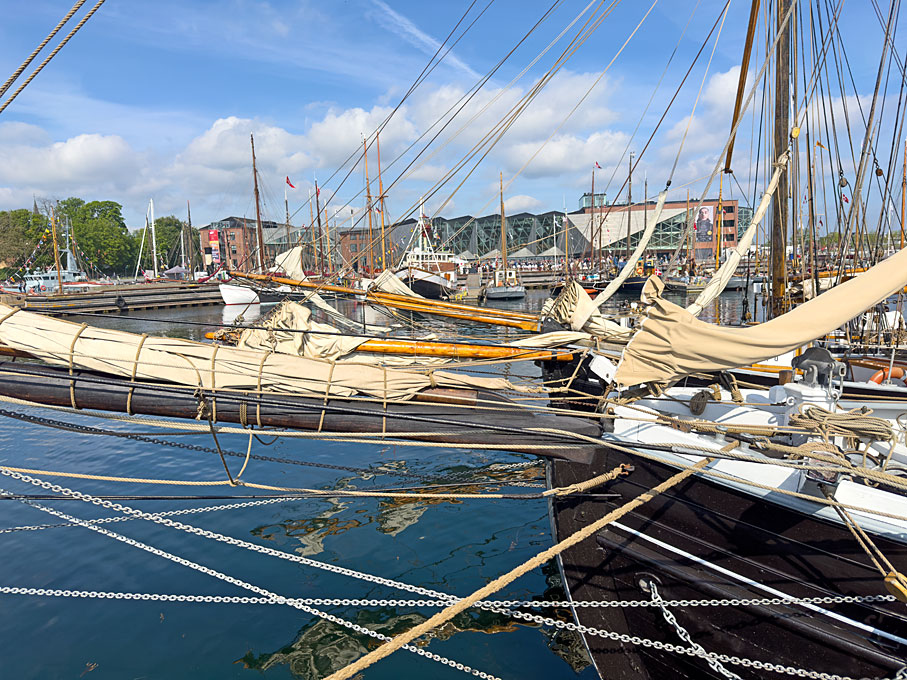
In between travels, I continued to work on small bits and pieces, but nothing has progressed to a stage that can be shown yet.
Updates to come soon …
The last few weeks since the posting at the end of April have been crazy with travelling. I have been two weeks to Switzerland, a week to Denmark, and another week in Spain, mainly for business reasons.
I extended that business-trip to Copenhagen by a few days in order to re-visit a few museums in and around the city, including the M/S Museet for Søfart in Helsingør, the Vikingeskibs Museet in Roskilde, and the Krigsmuseet in Copenhagen that now houses the naval collection from the Holmen.
It being the long Pentecost-weekend, there turned out to be a sailing ship gathering in the harbour of Helsingør in front of the Kronborg Castle (of Hamlet’s fame). Among the various schooners, galiots, and smacks (jagts) there was also JENSINE af HADERSLEV (https://www.jensine.dk), a Danish jagt originally built in 1852, so more or less contemporary with the Rahschlup. She has the kind of livery that I have chosen for my project.
Unfortunately, JENSINE was sort of parked in third row, so I could get close to her. However, there are a few shots from this event below.
In between travels, I continued to work on small bits and pieces, but nothing has progressed to a stage that can be shown yet.
Updates to come soon …
Eberhard
Former chairman Arbeitskreis historischer Schiffbau e.V. (German Association for Shipbuilding History)
--------------------------------------------------------------------------------------------------------------------------------------------------------------------------------------------
Former chairman Arbeitskreis historischer Schiffbau e.V. (German Association for Shipbuilding History)
--------------------------------------------------------------------------------------------------------------------------------------------------------------------------------------------
-
wefalck
- Posts: 2118
- Joined: Wed Sep 28, 2011 12:04 pm
- Location: Paris
- Contact:
Re: Pomeranian Rahschlup 1846 � 1/160 scale � Baltic trader
Cabin-skylight
Although I had already made this a while ago, I was not really satisfied with the product and decided to have another go. The skylight is a relatively low affair in order to clear the helm and also to not get into the way with deck-work in this area, such as tending the main boom-sheet. There are various designs for such skylights, but essentially, they consist of a gabled roof-structure in which the glass-panes are protected with metal bar. A contemporary example can be found in the illustration below.
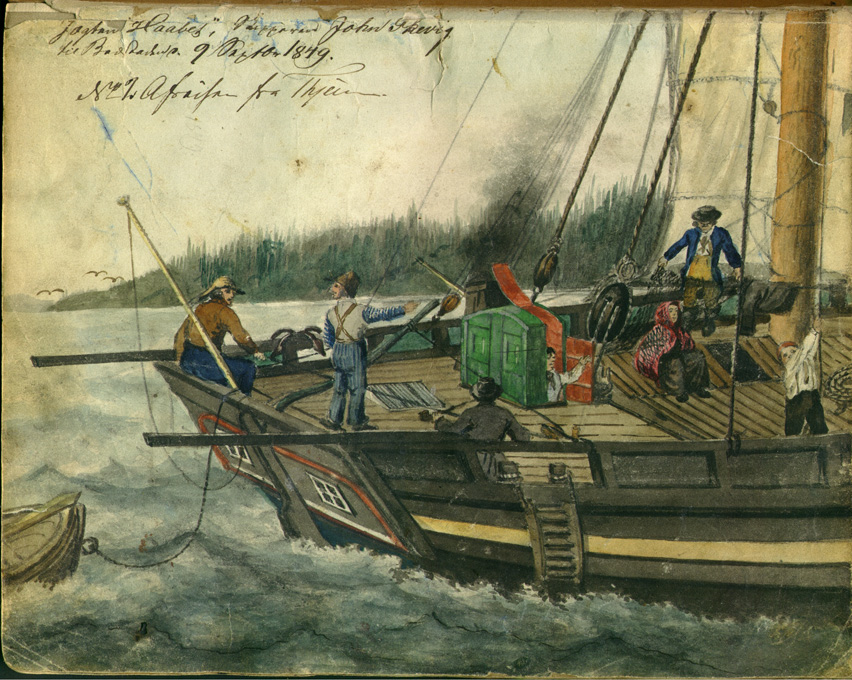
The Norwegian jægt HAABET (1849). Source: Town archives of Trondheim - https://www.flickr.com/photos/trondheim ... 3539132719.
Getting the bars, made from 0.1 mm copper-wire, straight and equidistant is a challenge. After several failed attempts, I decided to mill shallow grooves into the acrylic glass plug as a guide for the bars and this worked.
The plug for the skylight was milled from a piece of acrylic glass. Nothing special. The gabled roof was milled with the help of the angle-adjustable mini-vice. The fly-cutter already leaves a very smooth surface that is then polished by a couple of passes with a silicone rubber bit.
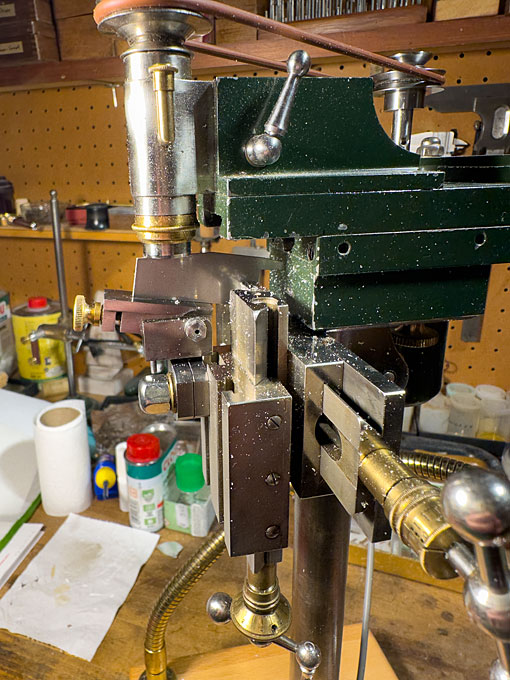
Adjusting the vice to the 10° angle to be milled with the help of a template
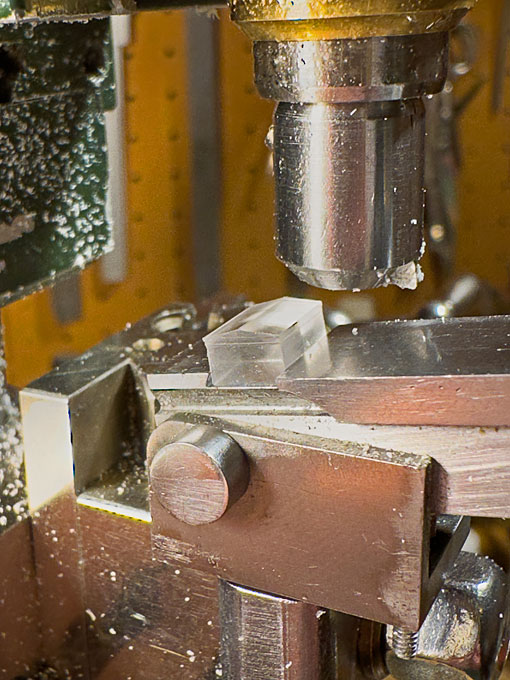
Fly-cutting the gabled-roof surfaces
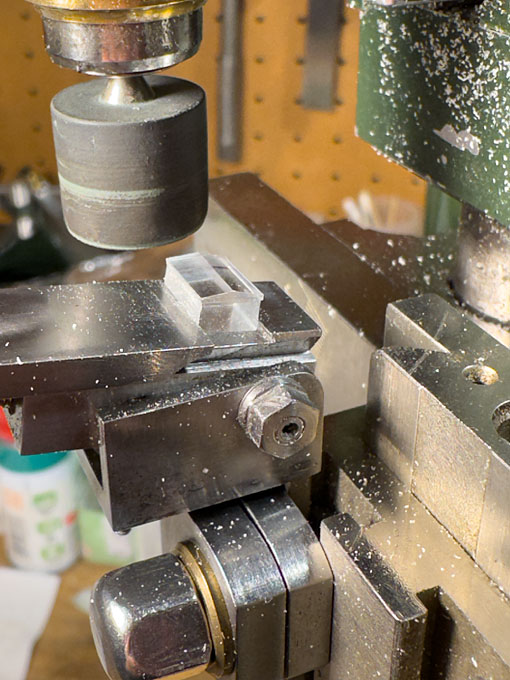
Polishing the surfaces
Then shallow grooves for the bars were milled with a pointed burr. Unfortunately, I forgot to take a picture of this set-up.
The frames for the bars were cut out from thin cardboard with the laser-cutter and the pre-painted. The bars from 0.1 mm brass-plated copper-wire were lacquered onto ‘roof’ structure, using the grooves as guide, taking care to only apply lacquer to areas that will be underneath the frame. The bars were trimmed to length and the pre-painted frames were lacquered on.
Overall, I am reasonably happy now with the result.
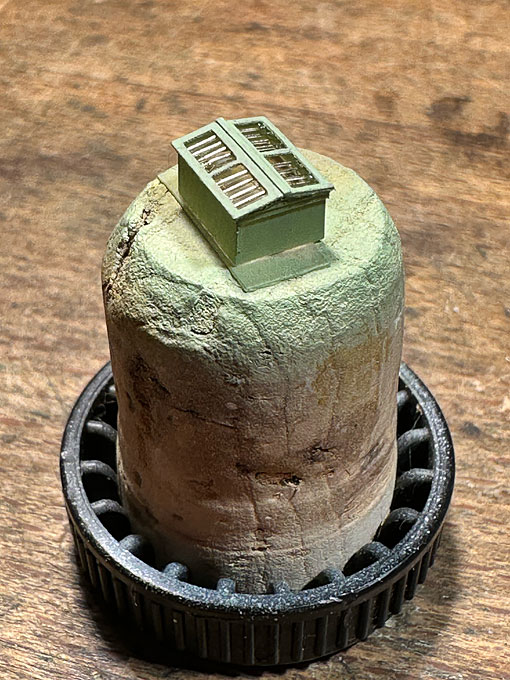
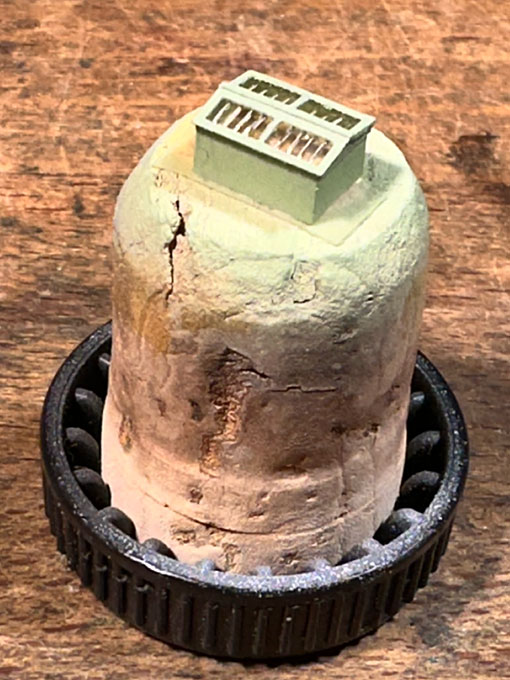
The finished skylight, ready to installed.
To be continued …
Although I had already made this a while ago, I was not really satisfied with the product and decided to have another go. The skylight is a relatively low affair in order to clear the helm and also to not get into the way with deck-work in this area, such as tending the main boom-sheet. There are various designs for such skylights, but essentially, they consist of a gabled roof-structure in which the glass-panes are protected with metal bar. A contemporary example can be found in the illustration below.
The Norwegian jægt HAABET (1849). Source: Town archives of Trondheim - https://www.flickr.com/photos/trondheim ... 3539132719.
Getting the bars, made from 0.1 mm copper-wire, straight and equidistant is a challenge. After several failed attempts, I decided to mill shallow grooves into the acrylic glass plug as a guide for the bars and this worked.
The plug for the skylight was milled from a piece of acrylic glass. Nothing special. The gabled roof was milled with the help of the angle-adjustable mini-vice. The fly-cutter already leaves a very smooth surface that is then polished by a couple of passes with a silicone rubber bit.
Adjusting the vice to the 10° angle to be milled with the help of a template
Fly-cutting the gabled-roof surfaces
Polishing the surfaces
Then shallow grooves for the bars were milled with a pointed burr. Unfortunately, I forgot to take a picture of this set-up.
The frames for the bars were cut out from thin cardboard with the laser-cutter and the pre-painted. The bars from 0.1 mm brass-plated copper-wire were lacquered onto ‘roof’ structure, using the grooves as guide, taking care to only apply lacquer to areas that will be underneath the frame. The bars were trimmed to length and the pre-painted frames were lacquered on.
Overall, I am reasonably happy now with the result.
The finished skylight, ready to installed.
To be continued …
Eberhard
Former chairman Arbeitskreis historischer Schiffbau e.V. (German Association for Shipbuilding History)
--------------------------------------------------------------------------------------------------------------------------------------------------------------------------------------------
Former chairman Arbeitskreis historischer Schiffbau e.V. (German Association for Shipbuilding History)
--------------------------------------------------------------------------------------------------------------------------------------------------------------------------------------------
-
EJFoeth
- Posts: 2924
- Joined: Wed Jan 21, 2009 1:51 pm
Re: Pomeranian Rahschlup 1846 � 1/160 scale � Baltic trader
Good progress, I like the polishing step that seems to, hmm, polish really well.
-
wefalck
- Posts: 2118
- Joined: Wed Sep 28, 2011 12:04 pm
- Location: Paris
- Contact:
Re: Pomeranian Rahschlup 1846 � 1/160 scale � Baltic trader
Thanks EJFoeth. I was surprised myself, when I first tried it this way some 20 years ago. As my father worked in the pharmaceutical branch of the company that manufactures the original Plexiglas (then Rhöm GmbH, now called Evonik), I obtained in the early 1980s their complete handbook for working with Plexigals, including the various polishing techniques. In the past I used the classical techniques of sanding and then polishing with polishing paste. These green silicone rubber bits with some polishing compound imbedded make the job on small parts much simpler.
With temperatures close to 40°C outside and 33°C in my study/workshop, the shipyard had to close down, hoping for more clement condistions next week

With temperatures close to 40°C outside and 33°C in my study/workshop, the shipyard had to close down, hoping for more clement condistions next week
Eberhard
Former chairman Arbeitskreis historischer Schiffbau e.V. (German Association for Shipbuilding History)
--------------------------------------------------------------------------------------------------------------------------------------------------------------------------------------------
Former chairman Arbeitskreis historischer Schiffbau e.V. (German Association for Shipbuilding History)
--------------------------------------------------------------------------------------------------------------------------------------------------------------------------------------------
-
EJFoeth
- Posts: 2924
- Joined: Wed Jan 21, 2009 1:51 pm
Re: Pomeranian Rahschlup 1846 � 1/160 scale � Baltic trader
Same here, the heat wave torturing France is heading here for the coming days with a chance we'lll see 40 degrees locally. Still trying to clean freshly vacuumed hulls though, hope they stay in shape in the heat 
I had some perspex windows made for a cavitation tunnel once but they were not as perfectly smooth as one would want (so not polished so nice I guess). Used them for optical measurements and always wondered if the quality would affect that, but in any case too late now. Hence I was slightly triggered by you action...
I had some perspex windows made for a cavitation tunnel once but they were not as perfectly smooth as one would want (so not polished so nice I guess). Used them for optical measurements and always wondered if the quality would affect that, but in any case too late now. Hence I was slightly triggered by you action...
-
wefalck
- Posts: 2118
- Joined: Wed Sep 28, 2011 12:04 pm
- Location: Paris
- Contact:
Re: Pomeranian Rahschlup 1846 � 1/160 scale � Baltic trader
For larger areas, flame-polishing is another method, but there may be slight optical distortions due to uneven thickness.
Eberhard
Former chairman Arbeitskreis historischer Schiffbau e.V. (German Association for Shipbuilding History)
--------------------------------------------------------------------------------------------------------------------------------------------------------------------------------------------
Former chairman Arbeitskreis historischer Schiffbau e.V. (German Association for Shipbuilding History)
--------------------------------------------------------------------------------------------------------------------------------------------------------------------------------------------
-
wefalck
- Posts: 2118
- Joined: Wed Sep 28, 2011 12:04 pm
- Location: Paris
- Contact:
Re: Pomeranian Rahschlup 1846 � 1/160 scale � Baltic trader
The number of visits to this building-log has exploded the last few weeks. Not sure, whether these were real visits or the result of 'bots' doing web-crawling ...
In between two heat-waves hitting Paris over the last three weeks I managed to overcome my lethargy and spend a bit of time in the yard.
Stern-davits
Theses vessels typically carried a small tender in stern-davits. It was used for general work around the vessel and ferrying people and lighter goods between the anchorage and the shore.
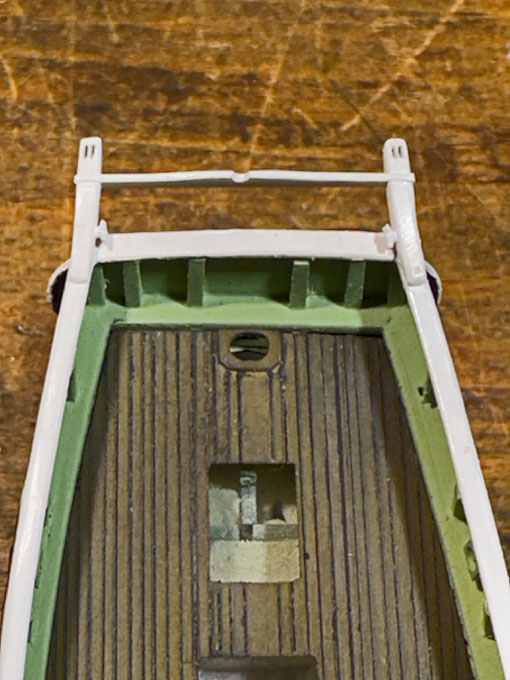
The davits were fashioned from pieces of 2 mm x 2 mm styrene rod. In a first step, these were slotted with a 0.2 mm saw on the milling machine for the halyards. These slots than were capped with small pieces of styrene. Finally, the curved shape of the davits was elaborated with fine files. The davits were cemented onto the capping rails.
A connecting piece was fashioned from a pieces of styrene rod 0.5 mm x 1.0 mm. This piece also serves as a support for the boom, when it is lowered.
Two cleats for the boat halliards were carved from styrene strip and cemented to each davit.
Bow monkey-railing
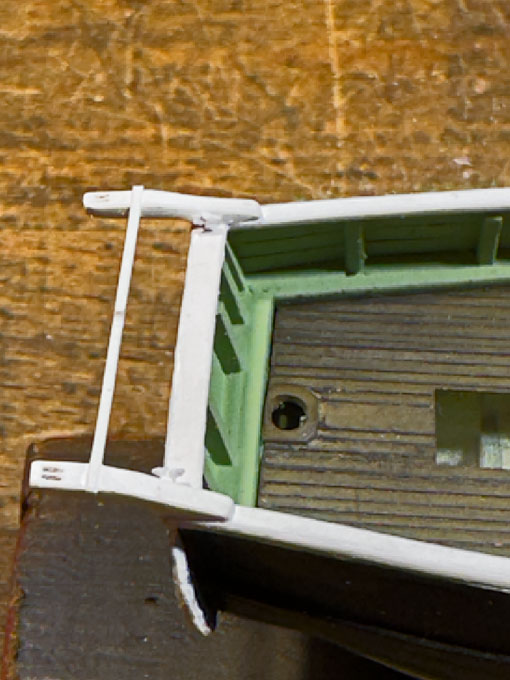
The capping rail at the bow on such vessels was surmounted by a kind of monkey-railing. Into this monkey-railing fairleads for hawsers and for the down-hauls etc. for the jibs are cut. This piece was bent from a 0,5 mm x 1,5 mm styrene strip, cut to length and cemented in place. The further shaping took place in situ.
With all these pieces in place, the rails etc. were painted white.
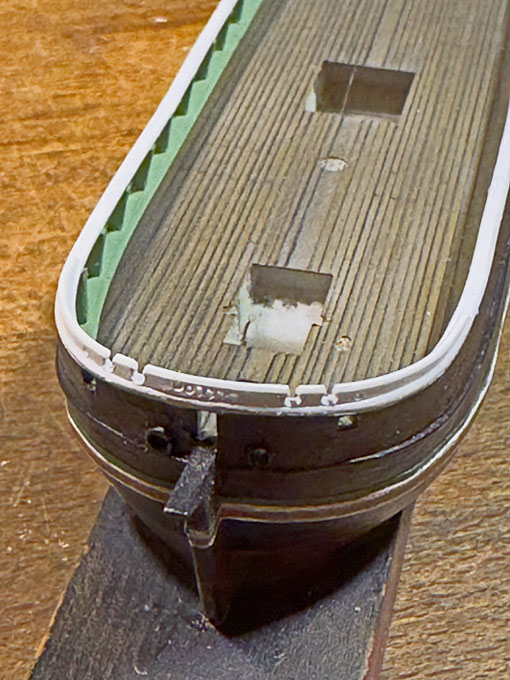
At this moment also the deck was permanently glued in place. Before that it was assured that the mast could be stepped at the correct angle and the hole for the mast opened to the correct diameter.
To be continued (heat permitting) …
In between two heat-waves hitting Paris over the last three weeks I managed to overcome my lethargy and spend a bit of time in the yard.
Stern-davits
Theses vessels typically carried a small tender in stern-davits. It was used for general work around the vessel and ferrying people and lighter goods between the anchorage and the shore.
The davits were fashioned from pieces of 2 mm x 2 mm styrene rod. In a first step, these were slotted with a 0.2 mm saw on the milling machine for the halyards. These slots than were capped with small pieces of styrene. Finally, the curved shape of the davits was elaborated with fine files. The davits were cemented onto the capping rails.
A connecting piece was fashioned from a pieces of styrene rod 0.5 mm x 1.0 mm. This piece also serves as a support for the boom, when it is lowered.
Two cleats for the boat halliards were carved from styrene strip and cemented to each davit.
Bow monkey-railing
The capping rail at the bow on such vessels was surmounted by a kind of monkey-railing. Into this monkey-railing fairleads for hawsers and for the down-hauls etc. for the jibs are cut. This piece was bent from a 0,5 mm x 1,5 mm styrene strip, cut to length and cemented in place. The further shaping took place in situ.
With all these pieces in place, the rails etc. were painted white.
At this moment also the deck was permanently glued in place. Before that it was assured that the mast could be stepped at the correct angle and the hole for the mast opened to the correct diameter.
To be continued (heat permitting) …
Eberhard
Former chairman Arbeitskreis historischer Schiffbau e.V. (German Association for Shipbuilding History)
--------------------------------------------------------------------------------------------------------------------------------------------------------------------------------------------
Former chairman Arbeitskreis historischer Schiffbau e.V. (German Association for Shipbuilding History)
--------------------------------------------------------------------------------------------------------------------------------------------------------------------------------------------
-
JIM BAUMANN
- Posts: 5689
- Joined: Mon Jan 10, 2005 5:30 pm
- Location: Nr Southampton England
Re: Pomeranian Rahschlup 1846 � 1/160 scale � Baltic trader
Its certainly coming on now--appears to be taking shape!!
....I buy them at three times the speed I build 'em.... will I live long enough to empty my stash...?
http://www.modelshipgallery.com/gallery ... index.html
IPMS UK SIG (special interest group) www.finewaterline.com
http://www.modelshipgallery.com/gallery ... index.html
IPMS UK SIG (special interest group) www.finewaterline.com
-
wefalck
- Posts: 2118
- Joined: Wed Sep 28, 2011 12:04 pm
- Location: Paris
- Contact:
Re: Pomeranian Rahschlup 1846 � 1/160 scale � Baltic trader
Thanks, Jim, much appreciated !
****************************************
Just a sign of life from this building log. Apart from the heat, I also spent a week away on travelling again.
Practical workshop-work is stalling at the moment, while I am working out the details of the mast and the spars. The original drawings only give the lengths and the maximum diameter. Some measures can also be taken off the sail-plan, but all the other details have to be reconstructed from (contemporary if possible) sources. Not so easy to find for small commercial vessels.
I also have to make a decision on the material(s) to use. In principle, I am inclined towards steel for its stiffness, but cross-drilling is more difficult and attaching elements such as hounds and cross-trees will likely require some complex soldering. The mast has a diameter of only 2.6 mm at its thickest part and the yards, boom and gaff etc. will be considerably thinner.
So bear with me for the time being.
****************************************
Just a sign of life from this building log. Apart from the heat, I also spent a week away on travelling again.
Practical workshop-work is stalling at the moment, while I am working out the details of the mast and the spars. The original drawings only give the lengths and the maximum diameter. Some measures can also be taken off the sail-plan, but all the other details have to be reconstructed from (contemporary if possible) sources. Not so easy to find for small commercial vessels.
I also have to make a decision on the material(s) to use. In principle, I am inclined towards steel for its stiffness, but cross-drilling is more difficult and attaching elements such as hounds and cross-trees will likely require some complex soldering. The mast has a diameter of only 2.6 mm at its thickest part and the yards, boom and gaff etc. will be considerably thinner.
So bear with me for the time being.
Eberhard
Former chairman Arbeitskreis historischer Schiffbau e.V. (German Association for Shipbuilding History)
--------------------------------------------------------------------------------------------------------------------------------------------------------------------------------------------
Former chairman Arbeitskreis historischer Schiffbau e.V. (German Association for Shipbuilding History)
--------------------------------------------------------------------------------------------------------------------------------------------------------------------------------------------
-
wefalck
- Posts: 2118
- Joined: Wed Sep 28, 2011 12:04 pm
- Location: Paris
- Contact:
Re: Pomeranian Rahschlup 1846 � 1/160 scale � Baltic trader
Masting
I spent days ruminating around textbooks, contemporary images, photographs of (contemporary) models, etc. in order to understand what the geometry in particular of the lower mast of such small vessel from the Baltic could have looked like. There is a lot of information on larger merchant ships and in particular naval vessels, but comparatively little on such small ones. My working hypothesis was that the mast would be similar in construction to the fore-mast of a topsail schooner with lower mast and top-mast on which two square sails would be carried.
When I also went through the collection of beautiful drawings of masts of different types and sizes from the archives of the Danish Naval Yard (now in the Rigsarkivet), I realised that I already had partially solved my problem a long time ago: there is a set of beautifully rendered drawings for the spars of a two-masted freight-carrying top-sail schooner of the right size, albeit from 1811 rather than the 1840s. How parts of the masts are shaped in detail and how the cross-trees etc. are designed may vary from case to case, but overall, there have not been so fundamental changes over the decades. So, the drawings below, will be a good guidance for the reconstruction.
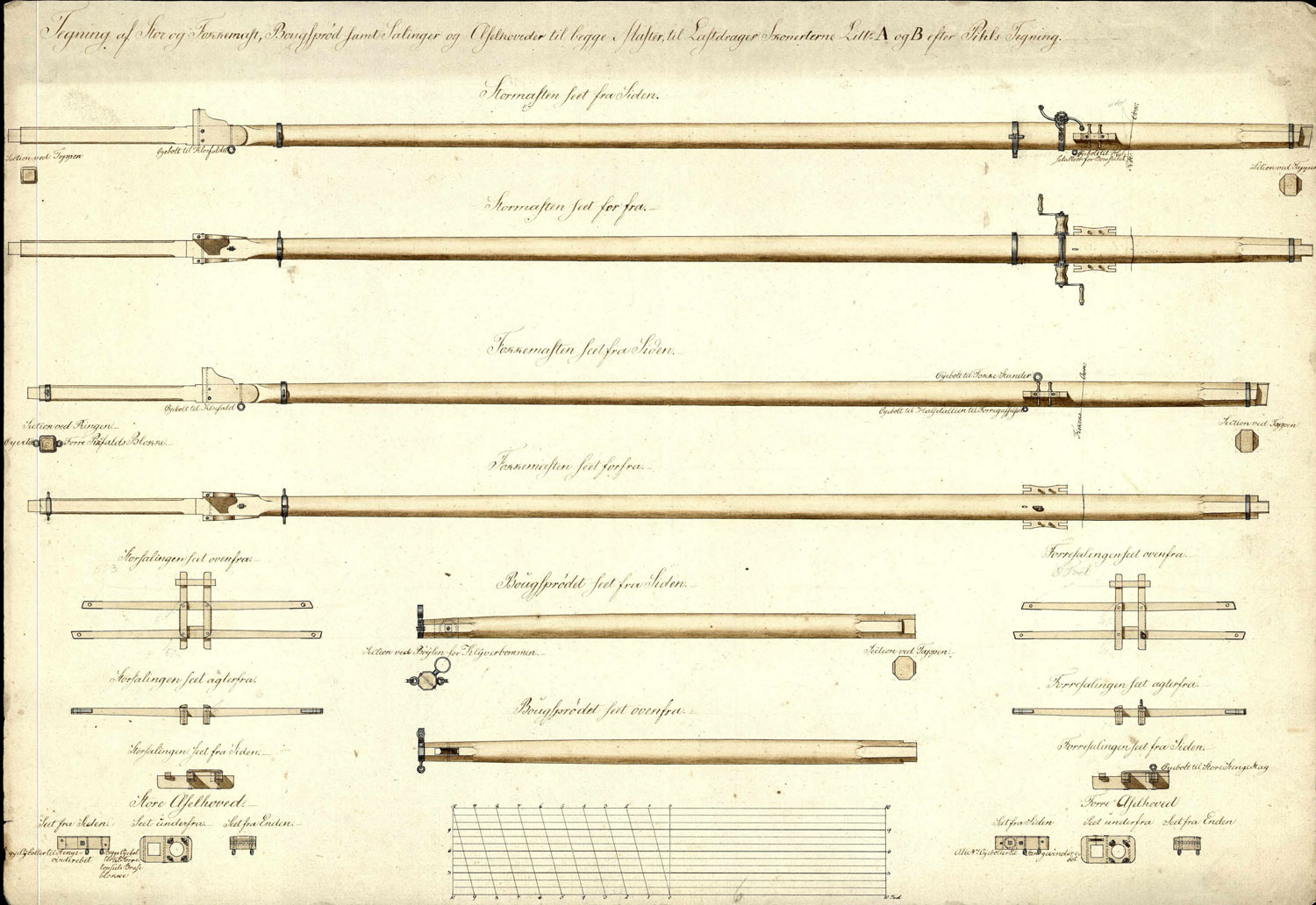
Masts and bowsprit for a top-sail freight schooner (G-4802-39, https://arkivalieronline.rigsarkivet.dk/)
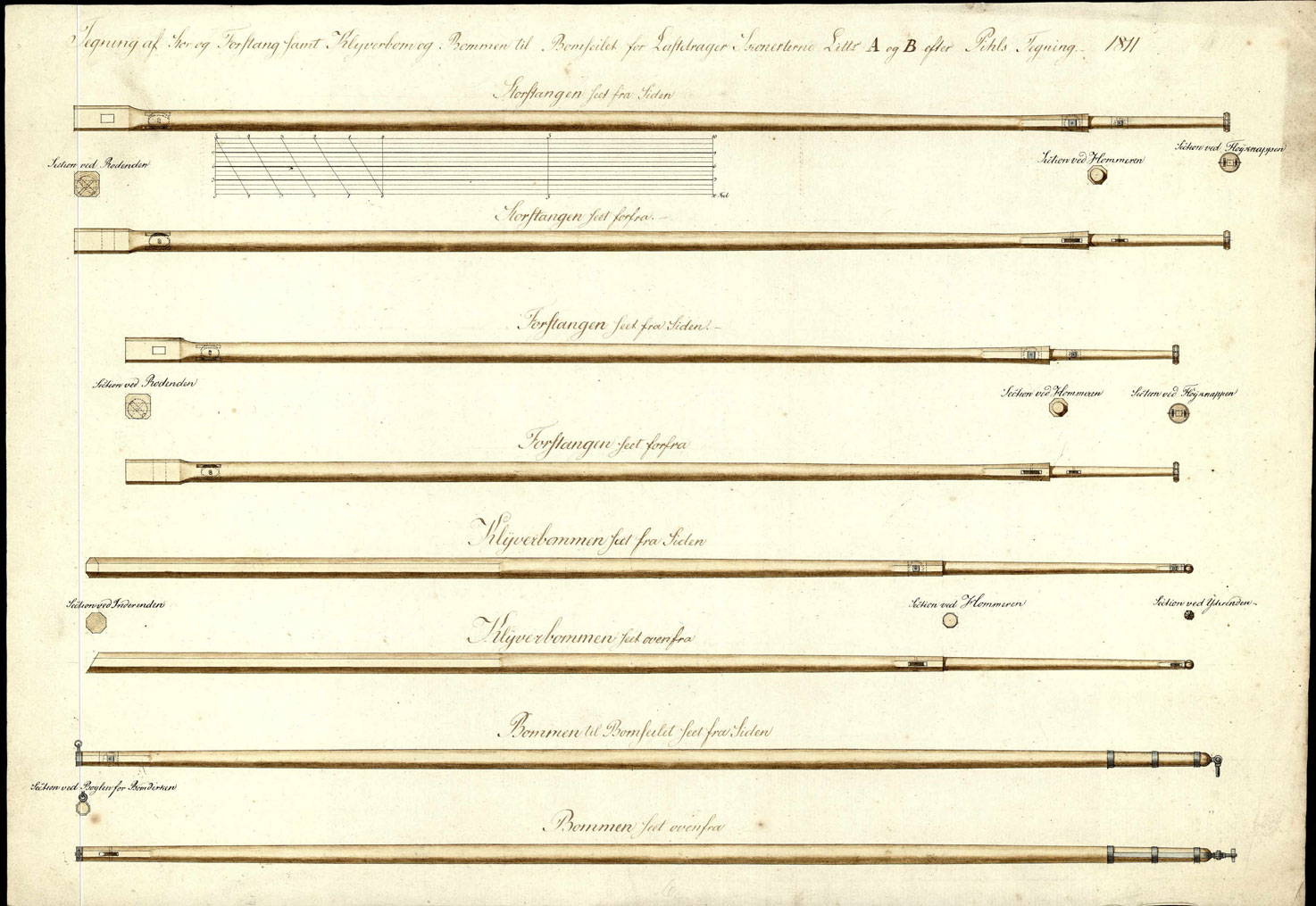
Top-mast for a top-sail freight schooner (G-4802-41, https://arkivalieronline.rigsarkivet.dk/)
The overall dimensions for the spars of the Rahschlup were given in a table on the original sail plan. The above drawings had to be scaled appropriately and some of the proportions, such as the length of the top adjusted to the given information.
Given the maximum and minimum diameters of 2.6 mm and 1.6 mm of the mast respectively, some simplifications will be unavoidable at the small scale of 1:160.
Below are my reconstruction drawings for the lower mast, the top-mast, the top and the cap-head set against the drawings from the Rigsarkivet.
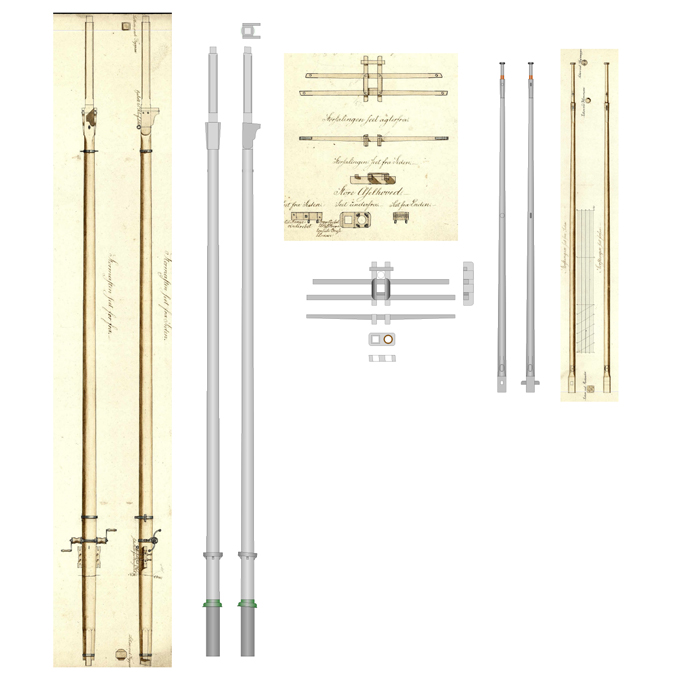
Reconstructed lower and top-mast, top and cap
Some details are still missing in the drawing. There will be a slightly more modern cargo-winch attached to the mast than the one drawn above, for which there is also a nice drawing in the Danish archive. Also, various ring-bolts etc. are not drawn yet, as these require more work on the reconstruction of the rigging.
I have been also thinking about the material(s) for the masting. In principle, I like masts made from steel rods. Turning and milling-on flats etc. are straightforward, but drilling holes of less than 0.5 mm diameter into steel is always something causing me quite a bit of anxiety., particularly when drilling into round material. Attaching parts, such as the hounds needs to be done by (silver) soldering, doable, but also a bit stressful. So, I have been thinking of using acrylic glass for the lower mast instead.
With a length of 113 mm above deck, a maximum diameter of 2.6 mm and a 1.7 mm square section at the doubling that seems to be sufficiently stable, even for brittle material such as the acrylic glass.
The top-mast, on the other hand tapers from a 1.7 mm square to only 0.85 mm diameter at the truck. Making it from acrylic glass may call for trouble. Brass or aluminium would be a safer option, also considering that it needs to cross-drilled for a couple of functional ‘sheaves’ (e.g. for the halliard of the topgallant yard). A couple of other sheaves, e.g. those for lifting the top-mast can be faked only.
To be continued …
I spent days ruminating around textbooks, contemporary images, photographs of (contemporary) models, etc. in order to understand what the geometry in particular of the lower mast of such small vessel from the Baltic could have looked like. There is a lot of information on larger merchant ships and in particular naval vessels, but comparatively little on such small ones. My working hypothesis was that the mast would be similar in construction to the fore-mast of a topsail schooner with lower mast and top-mast on which two square sails would be carried.
When I also went through the collection of beautiful drawings of masts of different types and sizes from the archives of the Danish Naval Yard (now in the Rigsarkivet), I realised that I already had partially solved my problem a long time ago: there is a set of beautifully rendered drawings for the spars of a two-masted freight-carrying top-sail schooner of the right size, albeit from 1811 rather than the 1840s. How parts of the masts are shaped in detail and how the cross-trees etc. are designed may vary from case to case, but overall, there have not been so fundamental changes over the decades. So, the drawings below, will be a good guidance for the reconstruction.
Masts and bowsprit for a top-sail freight schooner (G-4802-39, https://arkivalieronline.rigsarkivet.dk/)
Top-mast for a top-sail freight schooner (G-4802-41, https://arkivalieronline.rigsarkivet.dk/)
The overall dimensions for the spars of the Rahschlup were given in a table on the original sail plan. The above drawings had to be scaled appropriately and some of the proportions, such as the length of the top adjusted to the given information.
Given the maximum and minimum diameters of 2.6 mm and 1.6 mm of the mast respectively, some simplifications will be unavoidable at the small scale of 1:160.
Below are my reconstruction drawings for the lower mast, the top-mast, the top and the cap-head set against the drawings from the Rigsarkivet.
Reconstructed lower and top-mast, top and cap
Some details are still missing in the drawing. There will be a slightly more modern cargo-winch attached to the mast than the one drawn above, for which there is also a nice drawing in the Danish archive. Also, various ring-bolts etc. are not drawn yet, as these require more work on the reconstruction of the rigging.
I have been also thinking about the material(s) for the masting. In principle, I like masts made from steel rods. Turning and milling-on flats etc. are straightforward, but drilling holes of less than 0.5 mm diameter into steel is always something causing me quite a bit of anxiety., particularly when drilling into round material. Attaching parts, such as the hounds needs to be done by (silver) soldering, doable, but also a bit stressful. So, I have been thinking of using acrylic glass for the lower mast instead.
With a length of 113 mm above deck, a maximum diameter of 2.6 mm and a 1.7 mm square section at the doubling that seems to be sufficiently stable, even for brittle material such as the acrylic glass.
The top-mast, on the other hand tapers from a 1.7 mm square to only 0.85 mm diameter at the truck. Making it from acrylic glass may call for trouble. Brass or aluminium would be a safer option, also considering that it needs to cross-drilled for a couple of functional ‘sheaves’ (e.g. for the halliard of the topgallant yard). A couple of other sheaves, e.g. those for lifting the top-mast can be faked only.
To be continued …
Eberhard
Former chairman Arbeitskreis historischer Schiffbau e.V. (German Association for Shipbuilding History)
--------------------------------------------------------------------------------------------------------------------------------------------------------------------------------------------
Former chairman Arbeitskreis historischer Schiffbau e.V. (German Association for Shipbuilding History)
--------------------------------------------------------------------------------------------------------------------------------------------------------------------------------------------
-
marijn van gils
- Posts: 2707
- Joined: Tue Feb 06, 2007 10:24 am
- Location: Belgium
Re: Pomeranian Rahschlup 1846 � 1/160 scale � Baltic trader
Great research Eberhart!
I may be biased (because I don't have experience with acrylic glass but I do with brass), but maybe brass would work fine for the lower mast too?
The dimensions are similar to the masts on my models (smaller scale but larger ships ), and brass is certainly more than rigid enough for the lower masts. There is a bit of flex in my topgallant masts, but not enough to be an issue for rigging unless you put a lot of stress on it (which is best avoided anyway).
I had good luck drilling 0,2mm holes in them with my Proxxon MF70 micromill (very high spindle speed!). A test with 0,1mm in brass worked out fine too, but I didn't try it on a round surface (but only because I didn't need too).
Hounds etc. can be made from styrene and glued with a combination of CA and plastic glue. A plus of styrene is that it is easy to refine the shape of pieces after they are attached to the mast.
But on the other hand, I wouldn't mind seeing how you do these in acrylic glass!
I may be biased (because I don't have experience with acrylic glass but I do with brass), but maybe brass would work fine for the lower mast too?
The dimensions are similar to the masts on my models (smaller scale but larger ships
), and brass is certainly more than rigid enough for the lower masts. There is a bit of flex in my topgallant masts, but not enough to be an issue for rigging unless you put a lot of stress on it (which is best avoided anyway). I had good luck drilling 0,2mm holes in them with my Proxxon MF70 micromill (very high spindle speed!). A test with 0,1mm in brass worked out fine too, but I didn't try it on a round surface (but only because I didn't need too).
Hounds etc. can be made from styrene and glued with a combination of CA and plastic glue. A plus of styrene is that it is easy to refine the shape of pieces after they are attached to the mast.
But on the other hand, I wouldn't mind seeing how you do these in acrylic glass!