Jim -
In fairness to Trumpeter, I'm not sure how long the splinter shields were that high. I suspect they were raised at the same time the last work was done at PHNB. By the way, there are some good photos in the Wiper book showing at least some of the PHNB work being done: removing the 8" turrets for example. In my view, though, since the model was intended to be the Coral Sea fit, they could have done better. For those who are concerned about accuracy, we have at least some resources (such as this board) to make it as right as possible.
My love / hate, or perhaps more accurately stated 'stop / start', relationship with my LEX closely parallels my similar relationship with the HORNET. I only work on one ship at a given time, though I do put one aside for a period to work on another. After stalling out on HORNET trying to get the hull correct with several half hearted (or other half- portions of my anatomy), I picked up LEX and started out with a pretty good rhythm. I found a few things were off, including the splinter shields and the rudder, but they really aren't too hard to fix if done early. The main problem was the Flag Bridge which was changed during the PHNB work in March / April 1942. I had convinced myself I knew what the final result looked like, and built it accordingly. Still, I heard that Steve Wiper was doing an updated LEXINGTON photo book with pictures or documentation of the reconfigured bridge. I suspended work at that point because I knew that if I finished the LEX, the next day the book would come out and I'd be stuck. I returned to HORNET and have been going forward pretty well since then.
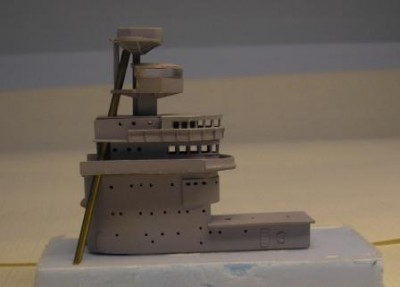
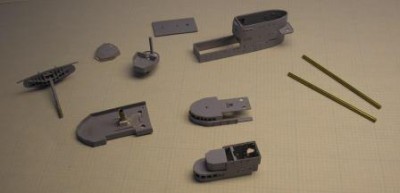
Here are some pictures of my version of the Flag Bridge. I note that Chris Smithers drew essentially the same conclusions as I did as to the shape of the Flag Bridge. There are pictures of SARA with a framework in the same area which was largely pipe and canvas or some similar material. I concluded that much like the simple shapes for the 1.1" splinter shields in the areas where the 8" turrets were removed, the same approach was used on the Flag Bridge for wartime expediency: lots of flat plates which could be placed and welded in a minimum of time. Note that my structure is incomplete, currently lacking the corrected details such as the correct positions for the searchlight platforms. I still have some cleanup work to do as well to fix a couple of flaws, but you get the general idea.
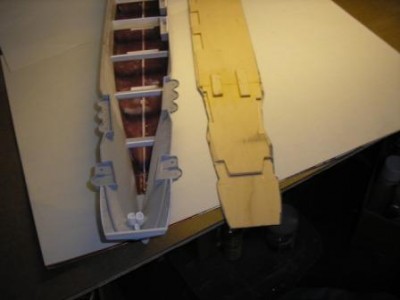
This photo shows that I have not yet changed the splinter shield height and size, but I will do so before attaching the flight deck. As you can see, my solution to the problem of fit of the wooden deck is to laminate 1/8" basswood to the underside of the FD and allow the basswood to force the hull straight. You can see that I have done some carving on the basswood so that it conforms to the hull flare. I also took the top off the boat pockets so I could detail them properly . I glued the bottoms of the pockets in place to add some rigidity to the hull sides so I could get the flight deck to fit square and tight before proceeding. If you look closely, you will see that I chose to expand the lower hull by cutting it lengthwise for the middle half of its length, then splicing in some (white) strip plastic strip to force the bottom of the hull outwards to meet the upper hull. Doing this also shortened the lower hull length slightly which also brought it into closer agreement with the upper hull length.
Some people make you happy, then they leave.
Others make you happy when they leave. (apologies to Oscar Wilde if he ever said anything similar, of which there is some doubt . . .)





 It will definitely be an adventure into new worlds for me.